
Crypto futures attract traders with the magic of a single number — leverage. The idea is seductively simple: with $5,000 in your account, you can control a $50,000 position. $10,000 becomes $100,000. Sounds like a superpower. And it truly is a powerful tool.
But here lies the core deception of perception. Futures trading is not about leverage. It is about risk architecture. It is about building a structure that withstands the hurricane-force winds of volatility rather than being torn apart by the first gust.
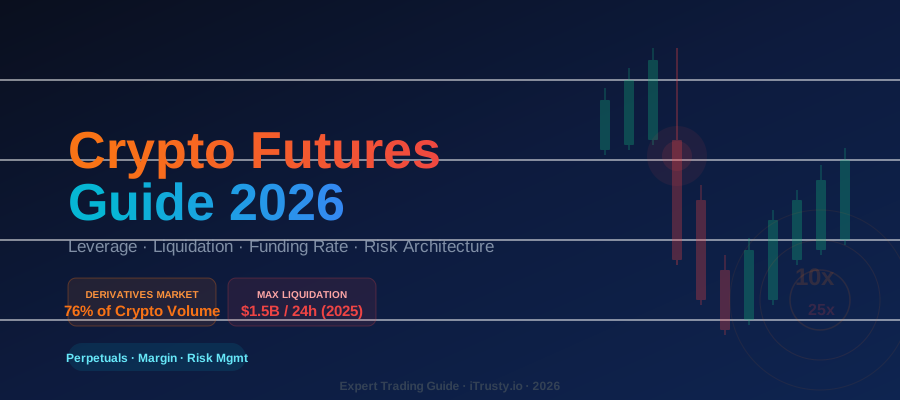
The scale of the derivatives market in 2025–2026 has become unprecedented. Monthly crypto derivatives trading volume hit a record $8.94 trillion in 2025. Bitcoin futures open interest grew to $16.3 billion (from $12B in 2024). Derivatives now account for 76% of total crypto trading volume. This is not a niche product — it is the core of the market.
Yet the data tells a sobering story: according to research on Brazilian futures day-traders, only around 1–3% of participants consistently profit over extended periods. 97% of day traders lose money on any given day after fees. This is not unique to crypto — it is a systemic pattern of any high-leverage market.
At iTrusty we observe two types of traders:
- Engineers: those who use futures as a precision tool for hedging, arbitrage, or carefully calibrated entries.
- Impulse gamblers: those who use futures as an emotion amplifier, hoping to hit a jackpot with a single move.
Only the first type survives multiple market cycles. The second typically disappears after the first serious crash, never understanding why their "genius bet" went to zero.
1. What Are Crypto Futures: Under the Hood
On the surface it is simple: a futures contract lets you speculate on an asset's price without owning it. But let us look deeper.
Perpetual futures (perpetual swaps) — what the vast majority of traders use — are synthetic instruments kept in parity with the spot market through a complex mechanism. They have no expiration date like classic futures. Instead, they rest on three pillars:
- Funding Rate: periodic payments between long and short positions that peg the futures price to spot. According to Kaiko, perpetual contracts account for 68% of all Bitcoin trading volume in 2025 (up from 66% in 2024). This is the dominant pricing instrument in the market.
- Margin Requirements: the collateral you post to open and maintain a position. On CME, margin for micro BTC contracts is ~24% of contract value. Unregulated exchanges allow margin as low as 0.5–1% (100–200x leverage), radically increasing risk.
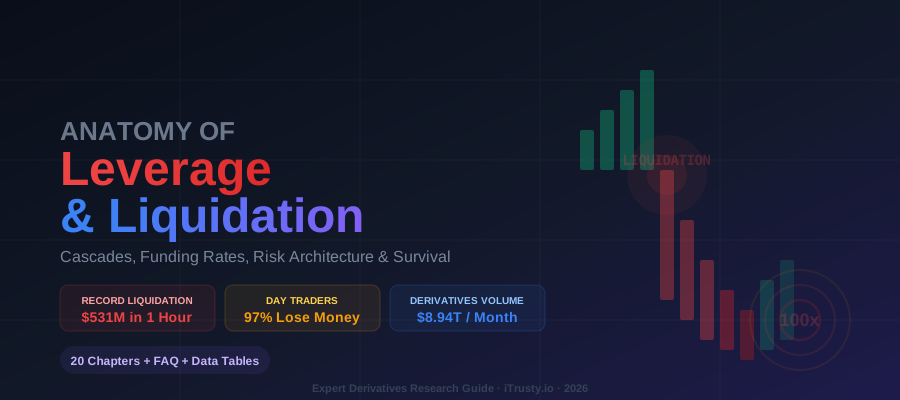
- Liquidation Engines: automated systems that force-close positions when collateral becomes insufficient. In March 2025, $531M in positions were liquidated in a single hour — one of the most intense hourly cascades of 2025.
Think of it as renting a car with a full tank. You do not own the vehicle (the asset), but you can drive it. You pay "rent" (funding) for the right to operate it, and if you damage the car (loss) beyond your deposit (margin) — it gets repossessed (liquidation). Understanding this mechanic separates professionals from amateurs.
1.1. Market Structure in 2025–2026: Who Dominates
| Exchange | Market Share | Distinction |
|---|---|---|
| Binance | ~36% | Volume leader |
| OKX | ~21% | Second place |
| Bybit | ~21% | Growing through liquidity |
| dYdX (DeFi) | ~10% | Doubled volume in 2025 |
| BitMEX | ~4% | High leverage niche |
In December 2025, Binance surpassed CME in Bitcoin futures open interest for the first time: ~125,000 BTC ($11.2B) at Binance vs ~123,000 BTC ($11B) at CME. This occurred because the basis trade became less attractive — the spread between spot and futures compressed from ~15% annualized to ~5%. Key trend: over 97% of crypto derivatives volume is processed on unregulated exchanges.
2. Leverage: Tool or Weapon of Self-Destruction?
Leverage is simply a multiplier. It multiplies everything: profits, losses, and — most importantly — emotions.
2.1. How It Works Mathematically
Capital: $10,000. Leverage: 10x. Position: $100,000.
- If price moves up +5%: profit $5,000 (50% of your capital). Euphoria.
- If price moves down -5%: loss $5,000 (50% of capital). Panic.
The key point beginners miss: liquidation strikes long before price drops -10%. The exchange requires you to maintain a certain collateral level (maintenance margin). The higher the leverage, the closer the "red button" sits to your entry price.
2.2. Real-World Liquidation Example
| Parameter | Value |
|---|---|
| BTC Price | $50,000 |
| Long Position | $100,000 |
| Margin | $10,000 (10x leverage) |
| Liquidation Threshold | ~$45,000 (drop of ~8–10%) |
Seems like a buffer. But add entry fees, volatility, and spreads — and the effective distance to liquidation compresses to 7–9%. 10x leverage is not "moderate" risk. It is an aggressive game where a single bad move wipes out half your deposit or all of it.
2.3. Crypto Leverage vs. Traditional Markets
| Venue | Margin | Max Leverage | Volatility |
|---|---|---|---|
| CME (BTC Futures) | ~24% | ~4x | High |
| S&P 500 Futures | ~5% | ~20x | Low |
| Crypto Exchanges (unreg.) | 0.5–1% | 100–200x | Very high |
Maximum leverage on crypto exchanges is not a trading tool — it is a marketing lure designed for inexperienced traders.
3. The Mathematics of Liquidation: A Professional View
Liquidation is not simply "position closed." It is a forced execution at market conditions at the worst possible moment.
The formula is simple: liquidation occurs when margin balance ≤ maintenance margin requirement. The higher your leverage, the smaller the percentage move needed to consume your collateral.
3.1. The Cost of Liquidation: Hidden Expenses
When liquidation triggers, the exchange:
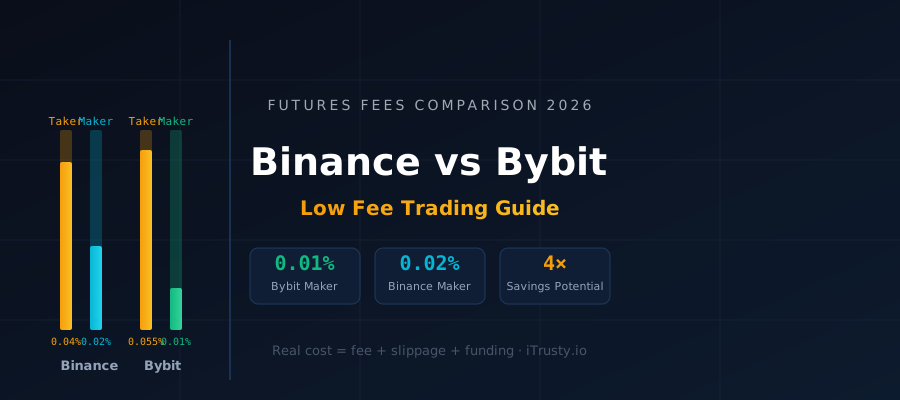
- Force-executes your order at market (you pay taker fees — typically 0.04–0.06%).
- Often charges an additional penalty (liquidation fee, 0.5–1.5% of position).
- May expose you to auto-deleveraging (ADL) if the insurance fund cannot cover the losses.
During market cascades, slippage can be massive. Your order may execute at a price far worse than the liquidation threshold, turning a -90% into -100% or even a negative balance.
3.2. 2025 Liquidation Data: A Chronicle of Losses
| Date | Scale | Primary Impact | Character |
|---|---|---|---|
| March 15, 2025 | $489M / 24h | BTC, ETH longs | Cascade in 1 hour |
| March 15, 2025 | $470M / 24h | Short squeeze | Short squeeze |
| March 21, 2025 | $531M / 1 hour | BTC longs (69%) | Record hourly |
| Sept. 22, 2025 | $1.5B / 24h | Longs (90%) | Largest of the year |
4. Funding Rate: The Silent Profit Killer
Funding is the most underestimated expense. Traders look at the chart, see potential profit, and forget that every 8 hours a "position usage tax" drips from their account.
This is a synthetic interest rate redistributed between traders. When the market is overheated and everyone is long, longs pay shorts to cool the frenzy. And vice versa.
4.1. Funding Math in Detail
Funding = Position Size × Current Funding Rate
| Parameter | Value |
|---|---|
| Position | $150,000 |
| Rate | 0.02% (average in bull market) |
| Periods per day | 3 (every 8 hours) |
| Daily cost | $150,000 × 0.02% × 3 = $90 |
| 2 weeks | $90 × 14 = $1,260 |
| 1 month | $90 × 30 = $2,700 |
For a swing trader holding positions for weeks, $1,260–$2,700 often exceeds the entire potential gain from the trade.
4.2. Funding as a Market Indicator
Professionals use funding not just as an expense but as a leading indicator. When funding spikes to 0.05–0.1% per period (common at euphoria peaks), the daily cost of holding a long reaches 0.15–0.3% of the position. For a $100,000 position that is $150–$300 per day, or $4,500–$9,000 per month. Extreme funding rates are one of the most reliable signals of an approaching correction.
5. Futures vs. Spot: The Arms Race
5.1. Comparative Table
| Parameter | Spot | Futures 5x |
|---|---|---|
| Capital | $100,000 | $50,000 (+reserve) |
| Exposure | $100,000 | $250,000 |
| Gross return | 20% | 12% on exposure |
| Costs | 5% (commissions) | 5% (commissions+funding) |
| Net return | 15% | 35% on capital |
| Capital after 3 years | ~$152,000 | ~$123,000* |
* Accounting for volatility drag and probability of partial liquidations.
On paper, futures win: 35% vs 15% annually. But in reality, volatility drag and liquidation risk change the picture. One bad month can set you back a full year.
6. Modeling Real Traders
6.1. Scenario A: Intraday Scalper (Maker)
| Parameter | Value |
|---|---|
| Trades per year | 500 |
| Average exposure | $400,000 |
| Maker fee | 0.01% (Bybit VIP) |
| Annual commissions | $80 × 500 = $40,000 |
If average profit per trade is 0.05% of exposure ($200), net profit is $100 per trade. Key detail: 81% of derivatives positions in 2025 closed within 24 hours.
6.2. Scenario B: Swing Trader (Taker + Funding)
| Parameter | Value |
|---|---|
| Trades per year | 40 |
| Exposure | $150,000 |
| Average holding period | 10 days |
| Trade cost | $150 |
| Funding | $675 |
| Total position cost | $825 |
To break even, the strategy must generate more than 0.55% profit on position size. Swing traders must calculate funding before entering — otherwise they operate at a loss.
6.3. Scenario C: Hedger (Institutional Approach)
Institutional players primarily use futures for basis trading: buying BTC on spot and simultaneously selling the futures contract, locking in the spread. In early 2025 this strategy yielded ~15% annualized, but by year-end the basis compressed to ~5%. This is why CME lost its open interest leadership — arbitrage opportunities shrank.
7. Stress Test: The Black Swan Arrives Without Warning
Imagine a sharp 15% market correction. What happens under the hood?
- Liquidation clustering: a chain reaction where one large liquidation pushes price further, killing the next positions.
- Spread widening: market makers pull liquidity, the order book thins. Bid-ask spreads can widen 5–10x.
- Slippage goes into orbit: your stop-loss may trigger 2–5% worse than the set level. In extreme cases — 10%+.
- Funding can flip: yesterday you were paying, today they pay you, but there is nothing to celebrate — your position is liquidated.
7.1. Anatomy of a Cascade Liquidation: March 2025
On March 15, 2025, the market experienced a multi-level cascade. $219M liquidated in the first hour. $489M over 24 hours. Liquidations hit all major exchanges: Binance, Bybit, OKX. Simultaneously, a $470M short squeeze struck — the market whipped in both directions, destroying bulls and bears alike.
8. Liquidation Heat Map Modeling
Most traders think about liquidation linearly. In reality, liquidations are a cascading process governed by crowd physics.
A liquidation heat map answers: where are positions concentrated that are ready to "explode" and push the market further? Tools like CoinGlass Liquidation Map allow visualization of high-risk zones.
- 8% drop: 20x leverage positions liquidate almost entirely (threshold ~5–6%). 10x positions enter the danger zone.
- 12% drop: most 10x longs liquidate. Forced selling triggers a new wave. The market falls into a "black hole."
9. Margin Sensitivity Tables
Starting conditions: Capital $20,000, BTC long entry at $40,000.
9.1. Price Move +5% (Profit)
| Leverage | Position Size | PnL | % of Capital |
|---|---|---|---|
| 2x | $40,000 | +$2,000 | +10% |
| 5x | $100,000 | +$5,000 | +25% |
| 10x | $200,000 | +$10,000 | +50% |
| 20x | $400,000 | +$20,000 | +100% |
9.2. Price Move -8% (Loss)
| Leverage | Loss | Remaining | Status |
|---|---|---|---|
| 2x | -$3,200 | $16,800 (84%) | Tolerable |
| 5x | -$8,000 | $12,000 (60%) | Painful |
| 10x | -$16,000 | $4,000 (20%) | Critical |
| 20x | -$32,000 | ~$0 | Liquidation |
Notice how leverage compresses the safety margin not linearly but exponentially. Traders think leverage multiplies profit. In reality, it multiplies fragility.
10. The Psychology of Leverage: The Enemy Within
Leverage changes not only your balance but also your psyche:
- Distorted volatility perception: a 1% move at 10x leverage feels like 10%. This drives impulsive decisions.
- Escalation after wins: after a winning streak you want to increase the bet. After losses — to make it back. Classic losing gambler behavior.
- Premature exits: fear of liquidation causes traders to exit too early, leaving profit on the table.
- FOMO and panic: 38% of crypto investors who ever held cryptocurrency sold at a loss due to emotional decisions.
Risk management discipline in futures matters a hundred times more than in spot. Spot is a walk in the park. Futures is driving a race car at maximum speed.
10.1. Why 97% of Day Traders Lose Money
A large-scale study of the Brazilian futures market (~20,000 beginning day traders): only ~3% consistently profit. 74% of day trading volume is generated by traders with no track record of success. Probability of trading again after a losing period: 95.3% — nearly the same as after a profitable one (96.4%). Results barely influence behavior. Overconfidence is the trader's greatest enemy.
11. Sharpe Ratio: The Truth About Risk
| Strategy | Return | Volatility | Sharpe |
|---|---|---|---|
| Spot | 18% | 25% | 0.72 |
| Futures 3x | 30% | 45% | 0.66 |
| Futures 5x | 40% | 70% | 0.57 |
| Futures 10x | 60% | 120% | 0.50 |
Leverage inflates returns faster than it improves risk-adjusted returns. A spot strategy with Sharpe 0.72 is mathematically more reliable than a futures strategy at 0.50.
Ready to Apply These Strategies?
Open an account on a trusted exchange and start trading futures with the risk management principles covered in this guide. Low fees, deep liquidity, advanced tools.
Affiliate links — we may earn a commission. Compare fees before choosing.
12. Exchange Infrastructure: A Matter of Life and Death
- Stable order matching engine: no crashes or freezes during high volatility.
- Transparent liquidation logic: you must know exactly at what price and how your position will be closed.
- Deep derivatives liquidity: adequate stop execution.
- Insurance funds: reserves covering losses from bad liquidations.
- Auto-deleveraging (ADL): the mechanism of last resort.
13. Regulatory Landscape 2025–2026: The New Reality
- Perpetual futures coming to the US: CFTC is reviewing applications to launch perps on regulated venues. Acting Commissioner Caroline Pham stated the CFTC is already evaluating such products.
- Hong Kong expanding the derivatives market: 9 licenses issued, 8 more under review. The region plans to approve new products including derivatives and margin lending.
- The unregulated benchmark problem: 97% of volume processed without regulatory oversight. This creates conditions reminiscent of the LIBOR scandal.
- Increased enforcement: CFTC conducted 32 enforcement actions in 2024 — 45% more than 2023.
Choose your venue deliberately. Saving on commissions is not worth the risk of losing funds if an unregulated exchange goes bankrupt.
14. Professional Risk Architecture
Five key parameters that determine long-term market survival:
- Maximum leverage used: professionals rarely exceed 5x on core capital.
- Funding awareness: exact cost of holding a position in dollars per day.
- Precision positioning: no more than 1–2% of capital per single trade.
- Distance to liquidation: minimum 3–5 ATR (Average True Range).
- Volatility adaptation: when volatility rises, positions must shrink.
15. 5-Year Simulation: The Price of Discipline
15.1. Scenario A: Disciplined Approach
| Parameter | Value |
|---|---|
| Capital | $50,000 |
| Effective CAGR | 20% |
| After 5 years | ~$124,000 |
15.2. Scenario B: Reckless Approach
| Parameter | Value |
|---|---|
| Capital | $50,000 |
| Net CAGR after losses | 10% |
| After 5 years | ~$80,500 |
Difference: $43,500. Discipline compounds. Recklessness compounds too — but with a minus sign.
16. Integrated Risk Model: Putting It All Together
- Commission drag: 3–7% of turnover annually.
- Funding drag: 5–15% of exposure in a bull market.
- Volatility drag: 5–20% depending on leverage.
- Liquidation probability: 1–3 times per 5 years with aggressive approach.
16.1. Conservative Approach
Capital: $50,000, gross return: 35%, costs: 7%, volatility drag: 5%. Resulting CAGR: 23%. $140,000 after 5 years.
16.2. Aggressive Approach
Gross return: 60%, costs: 12%, volatility drag: 15%. Liquidation every 2 years (50% capital loss). CAGR: 12%. $88,000 after 5 years.
17. Pre-Entry Checklist for Futures Positions
- Position size: no more than 1–2% of capital at risk.
- Current funding: check the last 7 days of history.
- Open interest: high OI + high leverage = fragility zone.
- Distance to liquidation: minimum 15–20% from current price.
- Calendar: do not open large positions before macro events.
- Stop-loss: set BEFORE opening the position.
- Reserve margin: keep at least 50% of capital in free margin.
18. Common Trader Mistakes: Anti-Patterns
- Mistake #1: "Golden leverage." 50x–100x — one 1–2% move and liquidation.
- Mistake #2: Ignoring funding. A 10x long on $200,000 for one month = $3,600 in "invisible" losses.
- Mistake #3: No stop-loss. Liquidation does not ask permission.
- Mistake #4: Averaging down with leverage. On 10x futures, adding to a losing position accelerates liquidation.
- Mistake #5: Trading with full deposit. Professionals never place more than 30–50% in active positions.
- Mistake #6: Meme coins with leverage. 30–50% daily volatility = virtually guaranteed liquidation.
19. Monitoring Tools for Futures Traders
- CoinGlass: liquidation heat maps, open interest, funding rates.
- Coinalyze: aggregated data, predicted funding rates.
- Bitcoin CounterFlow: BTC liquidation zone visualization.
- The Block Data: historical OI, volume, and liquidation data by exchange.
- Kaiko Research: institutional derivatives market analytics.
20. DeFi Derivatives: The New Frontier
dYdX doubled volumes in 2025 and holds 10% of the DeFi derivatives market. Open interest on DeFi derivatives platforms reached $1.45B by mid-2025.
- Advantages: no counterparty risk, transparent liquidations, no KYC.
- Risks: smart contract bugs, oracle manipulation, lower liquidity.
DeFi derivatives could reach 30% of the total derivatives market by 2026.
Conclusion
Crypto futures are not a shortcut to wealth. They are a tool for efficient capital management.
- 76% of all crypto trading is derivatives. You are at the epicenter of price discovery.
- 97% of day traders lose money. Overconfidence is the greatest enemy.
- $1.5B in liquidations in a single day in 2025. Cascades are real.
- 97% of volume on unregulated venues. Choose your exchange deliberately.
- Funding can cost 5–15% of exposure annually. Calculate before entering.
Professional futures trading is first and foremost risk architecture, and only then the magnitude of leverage.
FAQ
What is liquidation in crypto futures?
Liquidation is the forced closure of your position by the exchange when your collateral (margin) falls below the maintenance margin level. It happens automatically and instantly, without your consent.
What leverage is optimal for a beginner?
For beginners — no more than 2–3x. Even experienced professionals rarely exceed 5x on core capital. With 10x, an 8% price drop turns your capital into 20% of the original. With 20x — liquidation.
How do you calculate the cost of holding a futures position?
Total cost = opening commission + closing commission + (funding per period × number of periods). For a $100,000 position with 0.02% funding per 8 hours held for 10 days: $100 + $600 = $700.
How do perpetual futures differ from standard futures?
Perpetuals (perps) have no expiration date and are held at parity via funding. Standard futures expire on a set date. Perps account for ~68% of BTC trading volume.
How do you protect against cascade liquidations?
Moderate leverage (2–5x), pre-set stop-losses, 50%+ capital in free margin, monitor liquidation heat maps (CoinGlass), reduce positions before macro events.
Should you use DeFi platforms for futures?
DeFi derivatives (dYdX, GMX) offer transparency and no counterparty risk, but liquidity is lower. For large positions (>$50,000), centralized exchanges remain more reliable for now.