Crypto Futures Fees Compared: Find the Lowest Costs
Compare futures trading fees across major exchanges. Understand maker/taker structures and find the lowest costs for your strategy.
Trading fees directly impact your profitability, especially for active futures traders using leverage. Even small differences in maker/taker rates compound significantly over time.
This section compares fee structures across major exchanges including Binance and Bybit, and helps you minimize your total trading costs.
Related Sections
Frequently Asked Questions
What are typical crypto futures trading fees?▾
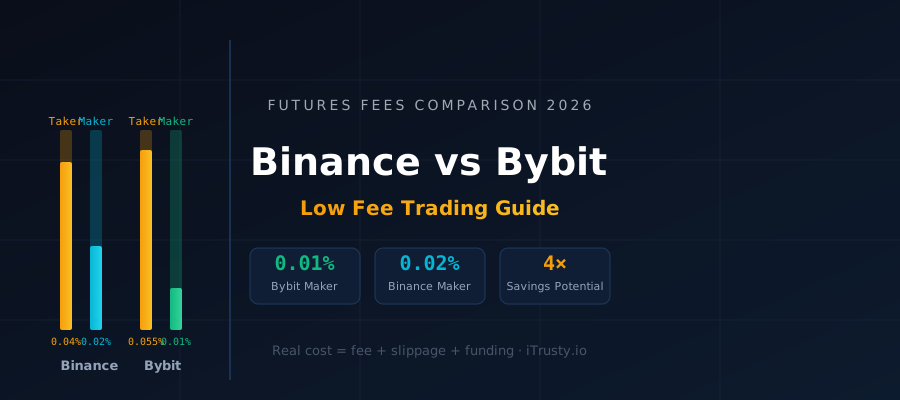
Most major exchanges charge 0.01-0.02% for maker orders (limit) and 0.04-0.06% for taker orders (market). VIP tiers and high volume can reduce these to near zero for makers. Binance and Bybit offer the most competitive rates.
What is the difference between maker and taker fees?▾
Maker fees apply when your order adds liquidity to the order book (limit orders that don't fill immediately). Taker fees apply when your order removes liquidity (market orders or limit orders that fill instantly). Makers typically pay lower fees or even receive rebates.
How do fees affect profitability with leverage?▾
Fees are charged on the full position size, not on your margin. With 10x leverage, a $1,000 margin controls a $10,000 position, so you pay fees on $10,000. At 0.05% taker, that is $5 per trade ($10 round trip) — or 1% of your actual capital.
Which exchange has the lowest futures fees?▾
As of 2026, Binance and Bybit offer the most competitive fee structures for futures. Binance base fees are 0.02%/0.05% (maker/taker), while Bybit offers 0.01%/0.06%. Both have VIP programs that further reduce fees based on trading volume.