
If you trade futures regularly, fees are not a minor detail. On $100,000 in volume, the difference between 0.01% and 0.04% is $30 per trade. Twenty trades a month — $600 in extra costs. Over a year, that is $7,200 that could have stayed in your pocket.
Binance and Bybit are the two largest platforms for crypto futures trading. Both offer a similar toolkit: perpetual contracts, quarterly futures, cross-margin and isolated margin, high leverage. But their fee structures are fundamentally different — and depending on your trading style, one can cost you several times more than the other.
This article is a practical comparison without marketing promises. Just numbers, calculations and conclusions.
What is actually included in the "fee"
Most traders only look at maker/taker fee. But the real cost of a trade consists of five components:
- Maker fee — you pay when you place a limit order and add liquidity to the order book.
- Taker fee — you pay when you take liquidity from the order book (market order or a limit order that executes immediately).
- Funding rate — a payment between longs and shorts every 8 hours. Can be positive (longs pay shorts) or negative. On average 0.01% per period, but during market overheating it can reach 0.3% and higher.
- Spread — the difference between the best bid and ask price. Lower on Binance due to greater liquidity.
- Slippage — especially relevant for large orders. Less on Binance due to order book depth.
Binance Futures Fees
Binance is the world's largest exchange by futures trading volume. Standard fees on USDT-M Futures (perpetuals):
| Tier | 30d Volume (BTC) | Maker | Taker |
|---|---|---|---|
| Regular | < 150 | 0.0200% | 0.0500% |
| VIP 1 | ≥ 150 | 0.0160% | 0.0400% |
| VIP 2 | ≥ 300 | 0.0140% | 0.0350% |
| VIP 3 | ≥ 600 | 0.0120% | 0.0320% |
| VIP 4 | ≥ 2,000 | 0.0100% | 0.0300% |
| VIP 5 | ≥ 4,000 | 0.0080% | 0.0270% |
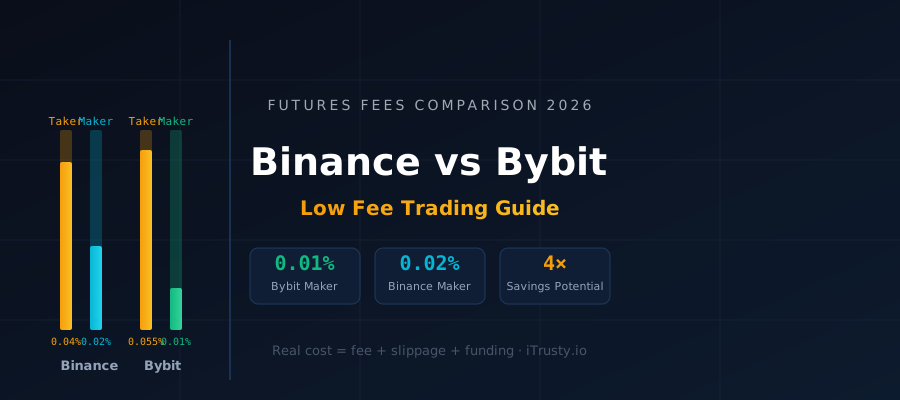
Why Binance is cheaper for takers: standard taker 0.05% — vs 0.055% on Bybit. For scalpers and algo traders working with market orders, this is significant. Plus the deep order book reduces slippage on large positions.
Where Binance is particularly advantageous:
- Trading top pairs (BTC, ETH) with large volume
- Using market orders (taker strategy)
- Arbitrage strategies (minimal spread)
- Institutional volumes — reaching VIP levels is realistic
Open a Binance Futures account
Go to Binance →Bybit Futures Fees
Bybit is the second-largest player by volume, known for its aggressive market maker program. Standard fees on USDT Perpetual:
| Tier | 30d Volume (USD) | Maker | Taker |
|---|---|---|---|
| Regular | < $1M | 0.0100% | 0.0550% |
| VIP 1 | ≥ $1M | 0.0080% | 0.0500% |
| VIP 2 | ≥ $10M | 0.0060% | 0.0450% |
| VIP 3 | ≥ $30M | 0.0040% | 0.0400% |
| VIP 4 | ≥ $100M | 0.0020% | 0.0350% |
| Pro | ≥ $500M | 0.0000% | 0.0300% |
Where Bybit wins: maker fee 0.01% — twice lower than Binance (0.02%). For traders who primarily work with limit orders, this is a significant advantage.
Ideal Bybit user:
- Swing traders holding positions for hours and days
- Traders with maker ratio > 60%
- Those who actively use the cashback program
- Bot strategy users with limit orders
Open a Bybit Futures account
Go to Bybit →Binance vs Bybit Comparison Table
| Parameter | Binance | Bybit |
|---|---|---|
| Maker fee (standard) | 0.0200% | 0.0100% |
| Taker fee (standard) | 0.0500% | 0.0550% |
| Maker fee (VIP min.) | 0.0000% (VIP 9) | 0.0000% (Pro) |
| Taker fee (VIP min.) | 0.0170% (VIP 9) | 0.0300% (Pro) |
| Liquidity (BTC) | ★★★★★ | ★★★★☆ |
| BTC-PERP spread | ~$0.1 | ~$0.2–0.3 |
| Funding rate | every 8h | every 8h |
| Cashback program | Lite voucher, BNB discount | 30% cashback |
| Ideal trader | Taker / arbitrage / institutional | Maker / swing / bots |
Calculation Example: $100,000 per Trade
Suppose you open and close a $100,000 position on BTC-PERP.
| Strategy | Binance | Bybit |
|---|---|---|
| Maker + Maker (limit/limit) | $40 ($20 × 2) | $20 ($10 × 2) |
| Taker + Taker (market/market) | $100 ($50 × 2) | $110 ($55 × 2) |
| Maker entry + Taker exit | $70 | $65 |
Conclusion: when working with limit orders only, Bybit is 2× cheaper. When working with market orders, Binance is 10% cheaper. Mixed strategy — near parity.
Don't forget to add the funding rate: holding a position for 24 hours at standard funding of 0.01% adds another $30 in costs.
How to Reduce Fees Even Further
On Binance:
- Lite Trading Voucher ($100) — covers fees on first trades. Available to new users through the referral program.
- BNB for fee payments — 10% discount when paying fees with BNB token.
- Referral Fee Rebate — a portion of your referrals' fees is returned to you.
On Bybit:
- 30% Cashback Program — 30% of paid fees returned monthly when trading conditions are met.
- Maker Pro — for volumes above $500M: zero maker fee.
- Trading bonuses — regular promotions with partial fee refunds.
Where Is It Cheaper to Trade Futures? The Verdict
There is no single answer — it depends on your trading pattern.
- Scalper / algo trader (market orders) → Binance. Lower taker fee (0.05% vs 0.055%), deeper liquidity, less slippage.
- Swing trader / position trader (limit orders) → Bybit. Maker fee 0.01% — 2× lower. With 20+ trades per month, the savings amount to hundreds of dollars.
- Institutional / high volume → Binance. VIP program is more transparent, infrastructure is more stable under peak loads, API is more reliable.
Practical rule: if your maker ratio is above 60% — go to Bybit. Below 40% — Binance is more profitable. Between 40–60% — calculate individually based on your volumes.
FAQ
What are maker and taker fees?
Maker fee — commission for adding liquidity (a limit order that doesn't execute immediately). Taker fee — commission for removing liquidity (market order or limit order at market price). On both exchanges, maker fee is lower than taker fee — exchanges incentivize market makers.
How do I find my maker/taker ratio?
In the order history on both exchanges, each trade is marked as maker or taker. Over a month, calculate sum of maker trades / total volume × 100%. If the result is > 60% — you are primarily a market maker.
Is the funding rate included in the comparison?
Not in this article — the funding rate on Binance and Bybit is determined by the market and is on average the same (both use the standard funding mechanism). Differences arise during anomalous divergences, but on the long run they even out.
Can I use both exchanges simultaneously?
Yes, and many professional traders do exactly that: they keep their main position where it is cheaper for their strategy, and use the second exchange for hedging or additional positions.
Do fees change?
Yes. Both exchanges periodically revise their fee structure. Current data is always on official pages: Binance Fee Schedule, Bybit Fee Structure. Data in this article is current as of early 2026.
Choosing an exchange for futures trading is not a question of "which is better", but "which is cheaper specifically for you". Calculate your pattern, compare the numbers and make decisions based on data, not marketing.