
If you've already outgrown spot trading "buy-sell" and feel ready for real action — welcome to the world of Futures on Bybit. Here you can make money on both rises and falls, use leverage, hedge risks, and move faster than the market can blink.
But let's be honest right away: Futures are the fastest way to either strike it rich or wipe out your deposit. Especially if you're a newbie who thinks "100x leverage is just a cooler number". Spoiler: it's not just a number, it's your quick ticket to the exit.
- How Perpetuals work and why they never sleep
- How to buy USDT and transfer them to Derivatives (to even start)
- How to choose leverage that won't kill you
- Why Funding Rate can eat your profit while you're drinking coffee
- And most importantly — how to make Futures a tool, not a casino
1. What are Futures and Perpetuals on Bybit
1.1. In simple terms about the complex
Imagine you want to make money on Bitcoin price, but you don't have actual Bitcoin. You simply make a bet: "I'm betting that BTC will go up". That's a Futures contract — a contract on an asset's price.
On crypto exchanges, Perpetual Futures (perpetual Futures) are most commonly traded. They have no expiration date — unlike commodity Futures that eventually need to be delivered. You can hold a position for a year, but there's a catch: the Funding Rate mechanism.
1.2. Difference from Spot and why you need this
| Trading Type | What you do | Can you Short | Need to own the asset | Leverage |
|---|---|---|---|---|
| Spot | Buy/sell real assets | No | Yes | No (1x) |
| Futures | Trade a price contract | Yes | No | Up to 100x |
What does this give you?
- Make money on falls (Short). Market crashing? You're in profit.
- Leverage. Have $100 but want to trade $1000? Easy.
- Hedge. Worried the price will drop but don't want to sell your asset? Open a Short on Futures and sleep peacefully.
2. Before starting: Account preparation
2.1. Security — mother of comfort
Before bringing money to the exchange, do these basic things:
- 2FA (Google Authenticator) — mandatory. SMS confirmation is old school.
- Anti-phishing code — if you get an email "from Bybit" without this code, know: it's scammers.
- Unique password — don't use the same one as your email.
2.2. Verification (KYC)
In 2026, Bybit, like all decent exchanges, requires verification. Without it, withdrawal limits are pathetic and some features are unavailable at all. The process is standard: passport/ID + selfie. Takes 5-10 minutes.
3. How to buy USDT and transfer to Derivatives
You have an account. But to trade Futures, you need money in your Derivatives wallet. Most Bybit trades are opened with USDT margin. The scheme is simple: Buy USDT → Transfer to Derivatives → Start trading.
3.1. Option A: P2P (Peer-to-Peer) — most popular in CIS and Asia
P2P is when you buy USDT directly from another person. Bybit acts as the transaction guarantor.
Step-by-step guide:
- Go to "P2P" section (usually in "Buy Crypto" menu).
- Select "Buy", currency — USDT, fiat — your local currency (RUB, UAH, KZT, IDR, etc.).
- Choose convenient payment method (bank card, transfer, Apple Pay/Google Pay).
- Filter sellers: number of trades (the more, the better), Completion rate 98-100%, no negative reviews.
- Click "Buy", transfer money to the seller strictly by their details.
- Click "Transferred, notify seller".
- Wait for the seller to release the USDT.
3.2. Option B: Buy through "Buy Crypto" (card)
If P2P seems complicated, you can buy directly through built-in providers (Banxa, Mercuryo, etc.). Pros: simple, fast, arrives straight to Spot wallet. Cons: commission higher than P2P, and the rate might not be the best.
3.3. Option C: Deposit from another wallet/exchange
If you already have USDT somewhere else:
- Go to Assets → Deposit.
- Select USDT.
- Select network. Most common beginner mistake: sending via ERC-20 when you need TRC-20 (Tron), losing money on gas or losing coins entirely. Check the network carefully!
- Copy the address and send USDT.
3.4. Transfer USDT to Derivatives (UTA)
Bybit has several internal wallets: Funding (P2P), Spot, Derivatives (UTA — Unified Trading Account). You need to transfer money to Derivatives.
How to make Transfer:
- Go to Assets.
- Click Transfer.
- From: Spot / Funding.
- To: Derivatives / UTA.
- Currency: USDT.
- Amount: All or how much you want.
- Confirm.
Done! Now USDT is there, and you can start.
4. Anatomy of Bybit Futures: terms that will save your deposit
Before clicking "Buy/Long" buttons, let's understand the basics. This isn't boring theory, this is your insurance.
4.1. Margin — your collateral
This is the money you "freeze" as security. Example: you want to open a $1000 position with 10x leverage — your margin will be $100.
4.2. Leverage — the accelerator of everything
Leverage multiplies your margin to get a larger position size. The formula is simple:
10x leverage = your $100 = $1000 position. Both profit and loss are calculated from the full $1000 position.
4.3. Isolated vs Cross Margin — choose wisely
This is the key choice that determines how fast you go to zero (or don't).
| Mode | How it works | Risk | For whom |
|---|---|---|---|
| Isolated | You allocate a specific amount for a trade. If the position goes negative, you only lose that money. Your remaining balance is safe. | Low (limited to one position) | MANDATORY FOR BEGINNERS |
| Cross | Your entire Derivatives balance acts as collateral for all positions. One bad bet can drag your whole account down. | High (can wipe everything) | Only for pros with a clear system |
4.4. Mark Price — your protection from manipulation
Liquidation on Bybit is calculated not by "Last Price" but by Mark Price — the "fair" price that accounts for spot prices from various exchanges. This protects against situations when someone suddenly jerks the order book to knock out stops.
4.5. Funding Rate — the tax on eternal happiness
Funding Rate is a mechanism that ties Perpetual Futures price to the spot price. Every 8 hours, payments are exchanged between Longs and Shorts.
- If Funding Rate is positive (most in Longs) — Longs pay Shorts.
- If Funding Rate is negative (most in Shorts) — Shorts pay Longs.
If you have a $100,000 position and the rate is 0.01%, every 8 hours you pay $10. Over 3 days it adds up to $90. This can eat your entire profit if you hold a position for long.
5. Commissions on Bybit: how much a trade really costs
5.1. Maker vs Taker: who pays less
Bybit uses the classic "maker-taker" model:
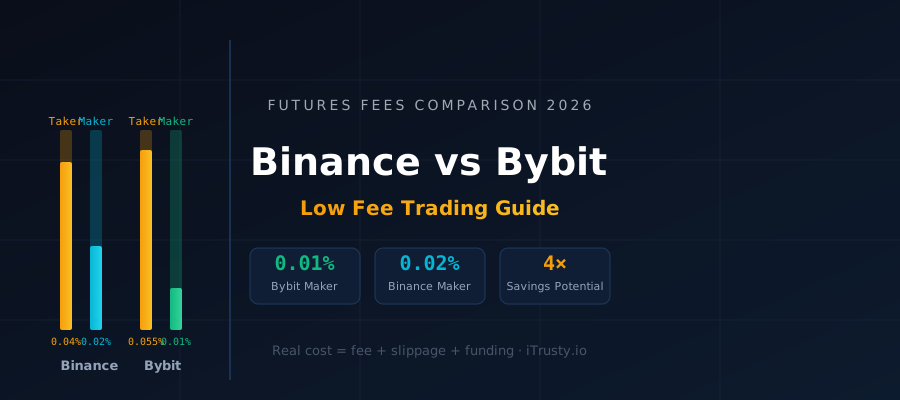
- Maker (Limit orders): You place an order in the book and wait. You create liquidity. Commission — 0.02%.
- Taker (Market orders): You buy what's in the book. You take liquidity. Commission — 0.055%.
Calculation example: You open a $10,000 position with a market order (Taker) and close it with a market order too. Entry: $10,000 × 0.055% = $5.5. Exit: $10,000 × 0.055% = $5.5. Total for trade: $11. Seems like pocket change? Now multiply by 100 trades a month. $1100 flies away on commissions.
5.2. How to save: VIP tiers and limit orders
| Tier | Volume (million USD) | Taker fee | Maker fee |
|---|---|---|---|
| VIP 0 | < 10 | 0.055% | 0.02% |
| VIP 1 | ≥ 10 | 0.04% | 0.018% |
| VIP 2 | ≥ 25 | 0.0375% | 0.016% |
| VIP 5 | ≥ 250 | 0.032% | 0.01% |
| Supreme VIP | ≥ 500 | 0.03% | 0.00% |
6. Risk limits: why you can't open an infinite position
Bybit uses a Risk Limits system. The point: the bigger your position, the less maximum available leverage and the higher margin requirements.
6.1. How it works
| Tier | Position size (USD) | Max Leverage | Maintenance Margin |
|---|---|---|---|
| 1 | ≤ 100,000 | 125x | 0.4% |
| 2 | ≤ 1,000,000 | 100x | 0.5% |
| 3 | ≤ 2,000,000 | 66.67x | 1.0% |
If you want to open a $1.5M position, you can't use 125x leverage anymore. The system automatically moves you to Tier 2 or 3. Large positions require more margin.
Ready to Start Futures Trading?
Open an account on a trusted exchange and start trading futures with the risk management principles covered in this guide. Low fees, deep liquidity, advanced tools.
Affiliate links — we may earn a commission. Compare fees before choosing.
7. Step-by-step algorithm: how to open your first position
Theory is over. Moving to practice. Keep this clear algorithm that separates a conscious trader from a casino gambler.
Step 1: Context and analysis (15 minutes)
Don't jump into a trade because "someone posted in a Telegram channel". Look at the chart:
- Timeframes: H4 / D1. Determine the trend (up, down, or sideways).
- Key levels: Where's support? Where's resistance?
- News: Is there a Powell speech or inflation report today? If yes, there might be a storm.
Step 2: Setup — concrete reason to enter
You should have an iron-clad reason to enter:
- Price touched a global support level and reversed.
- Trendline breakout with confirmation.
- Impulse with high volume.
Step 3: Trade plan (before opening!)
Write down in a notebook or notes:
- Entry point: Specific price (Limit order).
- Stop Loss (SL): Where does your idea break? Place it beyond the nearest local min/max.
- Take Profit (TP): Nearest target or cascade of targets.
- Risk in dollars: How much money are you willing to lose in this trade.
Step 4: Position size calculation (the most important!)
Never enter "by eye". Use the risk formula.
Deposit: $2000. Risk per trade: 1% = $20. Stop Loss: 50 pips (or 2% of price).
You need to calculate such a position size that when price moves against you by these 50 pips, you lose exactly $20.
Position size = Risk ÷ Stop Loss in money.
Step 5: Execution and orders
- Try to enter with Limit order, so you don't overpay as a Taker.
- Be sure to set TP and SL immediately. On Bybit you can do this when opening (TP/SL checkbox). Don't leave it for "later" — you'll forget or change your mind.
Step 6: Position management
Entered — don't sit trembling over the chart. Do something else. Check every hour. If price is moving in your favor, you can move Stop Loss to breakeven.
Step 7: Post-analysis
Closed the trade? Write in your journal: What did you think before entry? Did the plan work? What can be improved?
8. Liquidation: how to avoid "margin call"
8.1. Why this happens
Liquidation is not "fate" but a consequence of:
- Too much leverage. With 50x, just a 2% move against you wipes the position.
- No Stop Loss. You hoped for reversal, but market moved further.
- Averaging down losses. Adding to a losing position — fastest path to liquidation.
8.2. How to really protect yourself
- Isolated Margin. Only this way.
- Stop Loss. Always set it.
- Position size from risk. No more than 1-2% of deposit per trade.
- Don't average without a plan. Unless you're a hedge fund with infinite capital, don't do this.
- Consider volatility. On news and weekends, market might twitch harder.
9. How to choose the right leverage
Forget about "taking 100x to get rich in a minute". 100x is a tool for single scalping entries, not for holding.
| Leverage | Trader profile | Why |
|---|---|---|
| 2x – 3x | Beginner / Conservative | Has safety margin. Market can swing 10-15% and you're still alive. |
| 5x – 10x | Experienced / Swing trader | OK if you clearly know where your Stop is and don't hold forever. |
| 10x – 20x | Aggressive scalper | Only on 5-15 minutes. Holding more than an hour is dangerous. |
| 50x – 100x | Pro / Extreme risk | Extreme risk zone. One 1-2% move and you're in red. |
10. Psychology of Futures: how not to blow your deposit from emotions
10.1. The most expensive feelings
- FOMO (Fear Of Missing Out): You see price "rocketing" and jump in with a market order at the highs. Right after, it drops.
- Revenge trading: Blew a trade — and immediately open a new one to "get even". Usually leads to bigger losses.
- Hope: Price goes against you, and you think "it'll reverse now". It doesn't.
10.2. Two hard discipline rules
- Stop Loss is sacred. It's not losing money, it's paying for entry to the next opportunity.
- Daily loss limit. 2-3 losing trades in a row? Close the terminal. Go for a walk, watch a movie. The market won't disappear, but your deposit can.
11. Strategies for beginners
11.1. Trend-following (simple and works)
- Identify the trend on D1 or H4.
- Wait for a pullback to moving average or trendline.
- Enter in the direction of trend with a Limit order.
- Stop — beyond the local min/max.
11.2. From levels (for lovers of clear borders)
- Draw support/resistance levels.
- Wait for price to approach a level and show reaction (reversal candle, bounce).
- Enter from the level.
- Stop — slightly beyond the level.
11.3. "Don't trade" — the most profitable strategy
Sometimes the best trade is one you didn't open. If market is chaotic, news contradictory, and you haven't slept — just sit in stables. Preserving capital matters more than entering a trade.
12. FAQ: Frequently Asked Questions about Bybit Futures
Can I trade Futures on Bybit without experience?
You can, but don't immediately use 50x. Start with a demo account or minimal volumes, Isolated Margin and 2x leverage.
What's the difference between USDT Perpetual and Inverse (Coin-M) Futures?
U-based (USDT Perpetual): Margin and profit in USDT. Simpler for beginners.
Inverse (Coin-M): Margin and profit in the coin itself (e.g., BTC). Good for holders.
How often is Funding Rate charged?
Usually every 8 hours. Check the exact schedule for each contract.
What happens if I get liquidated?
Your position closes forcibly at market price. You lose the allocated margin (with Isolated) or part of balance (with Cross). The exchange uses an insurance fund to smooth slippage.
Can I withdraw USDT directly from Derivatives account?
No, you need to Transfer USDT back to Spot wallet first through Transfer, then withdraw from there.
Conclusion: How to make Futures a tool, not a casino
We've come a long way. From buying your first USDT to calculating liquidation prices and trading psychology.
Remember the main thing: Bybit Futures Trading is not a way to get rich quick, but a tool for effective capital management. In a skilled surgeon's hands, a scalpel saves lives; in a child's hands, it can hurt.
Your task is to become a surgeon. And for that you need three things:
- Risk management (position size from risk, stops, Isolated).
- Discipline (follow the plan, no revenge trading).
- Systematics (trade journal, error analysis).
Futures give you freedom: you can make money on falls, use leverage, and hedge risks. But the price of this freedom is constant control and a cool head.
Start small, trade consciously, and may the green candle always be on your side!