
Crypto futures attract traders with the magic of one number — leverage. The idea is seductively simple: with $5,000 in your account, you can control a $50,000 position. $10,000 becomes $100,000. Sounds like a superpower. And it really is a powerful tool. But here lies the core deception.
Futures trading is not about leverage. It's about risk architecture. It's about building a structure that withstands the hurricane force of volatility, rather than being destroyed by the first gust.
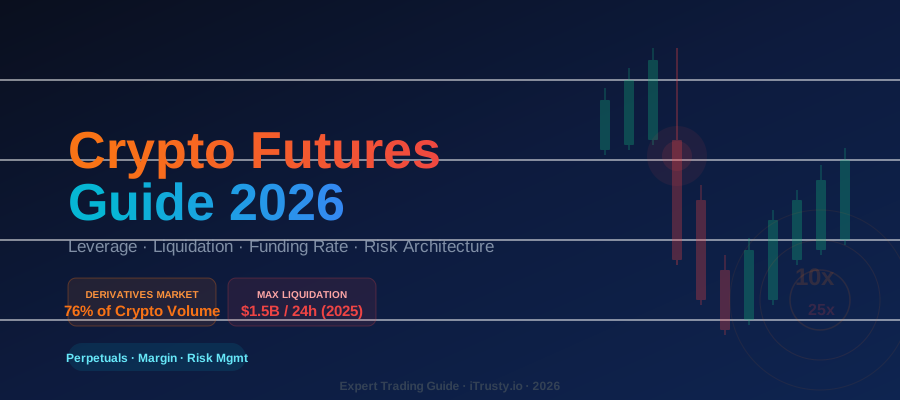
The scale of the derivatives market in 2025–2026 has become unprecedented. Monthly crypto derivatives trading volume hit a record $8.94 trillion in 2025. Bitcoin futures open interest grew to $16.3 billion (from $12B in 2024). Derivatives now account for 76% of total crypto trading volume. This is not a niche product — it is the core of the market.
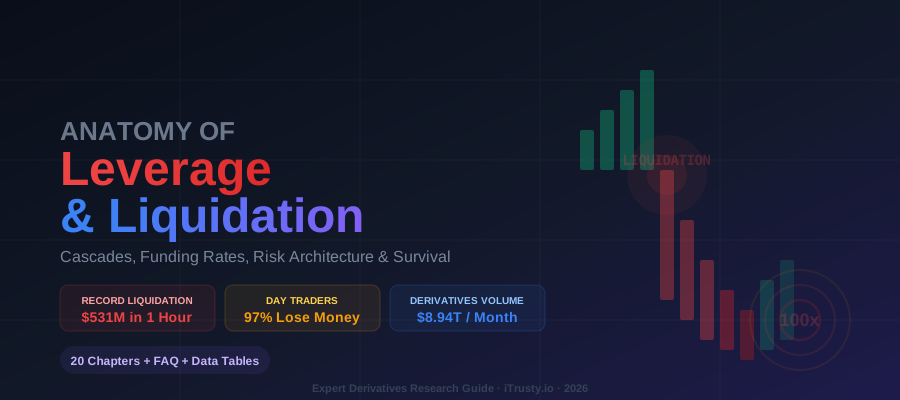
Yet the data tells a sobering story: according to research on the Brazilian futures day-trading market, only around 1–3% of participants consistently profit over extended periods. 97% of day traders lose money on any given day after fees.
At iTrusty we observe two types of traders:
- Engineers: those who use futures as a precision tool for hedging, arbitrage, or carefully calibrated entries.
- Impulse gamblers: those who use futures as an emotion amplifier, hoping to hit a jackpot with one move.
Only the first type survives multiple market cycles. The second typically disappears after the first serious crash, never understanding why their "genius bet" went to zero.
1. What Are Crypto Futures: Under the Hood
On the surface it's simple: a futures contract lets you speculate on an asset's price without owning it. But let's look deeper.
Perpetual futures (perpetual swaps) — what the vast majority of traders use — are synthetic instruments kept in parity with the spot market through a complex mechanism. They have no expiration date unlike classic futures. Instead, they rest on three pillars:
- Funding Rate: periodic payments between long and short positions that peg the futures price to spot. According to Kaiko, perpetual contracts account for 68% of all Bitcoin trading volume in 2025 (up from 66% in 2024). This is the dominant pricing instrument in the market.
- Margin Requirements: the collateral you post to open and maintain a position. On CME, margin for micro BTC contracts is ~24% of contract value. Unregulated exchanges like Binance and Bybit allow margin as low as 0.5–1% (100–200x leverage), radically increasing risk.
- Liquidation Engines: automated systems that force-close positions when collateral becomes insufficient. In March 2025, $531M in positions were liquidated in a single hour — one of the most intense hourly cascades of 2025.
Think of it as renting a car with a full tank. You don't own the vehicle (the asset), but you can drive it. You pay "rent" (funding) for the right to operate it, and if you damage the car (loss) beyond your deposit (margin) — it gets repossessed (liquidation).
1.1. Market Structure in 2025–2026: Who Dominates
| Exchange | Market Share | Distinction |
|---|---|---|
| Binance | ~36% | Volume leader |
| OKX | ~21% | Second place |
| Bybit | ~21% | Growing through liquidity |
| dYdX (DeFi) | ~10% | Doubled volume in 2025 |
| BitMEX | ~4% | High leverage niche |
In December 2025, Binance surpassed CME in Bitcoin futures open interest for the first time: ~125,000 BTC ($11.2B) at Binance vs ~123,000 BTC ($11B) at CME. Key trend: over 97% of crypto derivatives volume is processed on unregulated exchanges.
2. Leverage: Tool or Weapon of Self-Destruction?
Leverage is simply a multiplier. It multiplies everything: profits, losses, and — most importantly — emotions.
2.1. How It Works Mathematically
Capital: $10,000. Leverage: 10x. Position: $100,000.
- If price moves up +5%: profit $5,000 (50% of your capital). Euphoria.
- If price moves down -5%: loss $5,000 (50% of capital). Panic.
But the critical point beginners miss: liquidation occurs well before price drops 10%. The exchange requires maintaining a maintenance margin level. The higher your leverage, the closer the "red button" is to your entry price.
2.2. A Real Liquidation Example
| Parameter | Value |
|---|---|
| BTC Price | $50,000 |
| Long Position | $100,000 |
| Margin (10x leverage) | $10,000 |
| Approximate liquidation threshold | ~8–10% drop (to ~$45,000) |
It seems there's a buffer. But add entry fees, volatility, and spreads — and the effective distance to liquidation shrinks to 7–9%. 10x leverage is not a "moderate" risk. It's an aggressive game where one wrong move erases half your deposit or all of it.
2.3. Crypto Leverage vs Traditional Markets
| Market | Max Leverage | Typical Daily Volatility | Risk Level |
|---|---|---|---|
| CME Bitcoin Futures | ~4x | 3–5% | High |
| S&P 500 Futures | ~20x | 0.5–1% | Moderate |
| Binance / Bybit (crypto) | 125x | 3–10% | Extreme |
3. Liquidation Math: The Professional View
Liquidation is not simply "your position closed." It is a forced execution at market prices at the worst possible moment.
The formula is simple: liquidation occurs when margin balance ≤ maintenance margin requirement. The higher your leverage, the smaller the price move needed to trigger it.
3.1. Hidden Costs of Liquidation
- Force-executes your order at market (taker fee: 0.04–0.06%)
- Charges an additional liquidation penalty (0.5–1.5% of position)
- Exposes you to Auto-Deleveraging (ADL) risk if the insurance fund is depleted
- During cascades: slippage of 2–10% beyond your liquidation threshold
3.2. 2025 Liquidation Chronicle
| Date | Scale | Primary Impact | Character |
|---|---|---|---|
| Mar 15, 2025 | $489M / 24h | BTC, ETH Longs | 1-hour cascade |
| Mar 15, 2025 | $470M / 24h | Short squeeze | Both directions |
| Mar 21, 2025 | $531M / 1 hour | BTC longs (69%) | Record hourly cascade |
| Sep 22, 2025 | $1.5B / 24h | Longs (90%) | Largest of 2025 |
4. Funding Rate: The Silent Profit Killer
Funding is the most underestimated cost in futures trading. Traders look at the chart, see potential profit, and forget that every 8 hours a "position tax" is silently draining their account. This is not just a fee to the exchange — it is a synthetic interest rate redistributed between traders.
4.1. Funding Math in Detail
Funding = Position Size × Current Rate × Periods per Day
| Position | Rate / 8h | Daily Cost | 2-Week Cost | Monthly Cost |
|---|---|---|---|---|
| $150,000 | 0.02% | $90 | $1,260 | $2,700 |
| $150,000 | 0.03% | $135 | $1,890 | $4,050 |
| $150,000 | 0.05% | $225 | $3,150 | $6,750 |
For a swing trader holding a position for weeks, $1,260–$2,700 often exceeds the entire potential profit from the trade.
4.2. Funding as a Market Indicator
Professionals use funding not just as a cost item, but as a leading indicator. As of March 2025, the long/short ratio on major exchanges was ~50.55% to 49.45% — near equilibrium. Positive funding (0.01%) at this balance signals moderate optimism.
When funding spikes to 0.05–0.1% per period (at euphoria peaks), the daily cost of holding a long is 0.15–0.3% of position size. For a $100,000 position — $150–$300 per day, or $4,500–$9,000 per month.
5. Futures vs Spot: The Capital Efficiency Race
| Parameter | Spot | Futures 5x |
|---|---|---|
| Capital | $100,000 | $50,000 (+reserve) |
| Exposure | $100,000 | $250,000 |
| Gross return (20% move) | $20,000 | $50,000 |
| Costs (commissions + funding) | 5% | 5% |
| Net return on capital | 15% | 35% |
| Capital after 3 years | ~$152,000 | ~$123,000* |
*Accounting for volatility drag and probability of partial liquidations.
On paper futures win: 35% vs 15% annually. But this is an ideal world. In reality, two factors compound: volatility drag (you lose more on drawdowns) and liquidation risk. One bad month can set you back a year.
6. Real Trader Simulations
6.1. Scenario A: Intraday Scalper (Maker)
| Parameter | Value |
|---|---|
| Trades per year | 500 |
| Average exposure | $400,000 |
| Maker fee (Bybit VIP) | 0.01% |
| Round-trip cost per trade | $80 |
| Annual commission drag | $40,000 |
| Funding | Negligible (intraday) |
If average profit per trade is 0.05% of exposure ($200), net profit per trade is $100. Profitability here depends entirely on staying as a maker. Key data: 81% of all derivatives positions in 2025 closed within 24 hours. Scalping is the dominant strategy.
6.2. Scenario B: Swing Trader (Taker + Funding)
| Parameter | Value |
|---|---|
| Trades per year | 40 |
| Position size | $150,000 |
| Average holding period | 10 days |
| Taker fee (round-trip) | $150 |
| Funding (0.015% × 3 × 10 days) | $675 |
| Total position cost | $825 |
| Break-even requirement | +0.55% on position size |
Swing traders must calculate funding before entering a trade, otherwise they are working at a structural loss.
6.3. Scenario C: Hedger (Institutional Approach)
Institutional players primarily use futures for basis trading: buying BTC on spot and simultaneously selling futures to lock in the spread. At the start of 2025, this strategy yielded ~15% annually, but by year-end the basis had compressed to ~5%. This is precisely why CME lost its open interest lead — arbitrage opportunities diminished.
7. Stress Test: The Black Swan Strikes Without Warning
Imagine a sudden 15% market correction. Here's what happens under the hood:
- Liquidation clustering: chain reaction where one large liquidation pushes price further, killing the next.
- Spread widening: market makers remove liquidity. Bid-ask spreads can expand 5–10x.
- Slippage explodes: your stop-loss may execute 2–5% beyond your set level. In extreme cases — 10%+.
- Funding can flip: yesterday you were paying, today you receive — but it doesn't matter if your position was already liquidated.
In such moments, professionals don't just reduce sails (lower leverage) — they sail to a safe harbor (lock in profits in stablecoins) and wait out the storm.
7.1. Anatomy of a Liquidation Cascade: March 2025
- In the first hour: $219M liquidated
- Over 24 hours: $489M liquidated
- Liquidations hit all major exchanges: Binance, Bybit, OKX
- Long positions constituted the bulk of liquidations
- Simultaneously a $470M short squeeze occurred — the market lashed in both directions
The cascade's causes were typical: unexpected macro data, large whale movements, quarterly options expiry, and the self-reinforcing effect of cascading margin calls.
8. Liquidation Heat Map Modeling
Most traders think about liquidation linearly: "price dropped X% — I got kicked out." In reality, liquidations are a cascading process governed by crowd physics.
A liquidation heat map answers: where are the positions concentrated that are ready to "explode" and push the market even lower? Tools like CoinGlass Liquidation Map and Bitcoin CounterFlow visualize high-risk zones.
| Position Type | Share of OI | Liquidation Threshold |
|---|---|---|
| Longs 20x | 25% | ~5–6% drop |
| Longs 10x | 40% | ~8–10% drop |
| Longs 5x | 15% | ~15–18% drop |
9. Margin Sensitivity Tables
Starting conditions: $20,000 capital, long BTC at $40,000.
9.1. Price Move +5% (Profit)
| Leverage | Position Size | PnL | % of Capital |
|---|---|---|---|
| 2x | $40,000 | +$2,000 | +10% |
| 5x | $100,000 | +$5,000 | +25% |
| 10x | $200,000 | +$10,000 | +50% |
| 20x | $400,000 | +$20,000 | +100% |
9.2. Price Move -8% (Loss)
| Leverage | Loss | Remaining Capital | Status |
|---|---|---|---|
| 2x | -$3,200 | $16,800 (84%) | Manageable |
| 5x | -$8,000 | $12,000 (60%) | Painful |
| 10x | -$16,000 | $4,000 (20%) | Critical |
| 20x | -$32,000 | ~$0 | Liquidated |
Notice how leverage compresses your safety margin not linearly, but exponentially. Traders think leverage multiplies profits. In reality it multiplies fragility.
10. The Psychology of Leverage: The Enemy Within
- Volatility perception distortion: a 1% move at 10x feels like 10%. This drives impulsive decisions.
- Win escalation: after a winning streak you want to increase size. After losses — chase back with the same leverage. Classic casino loser behavior.
- Premature exits: fear of seeing liquidation often makes traders exit too early, leaving profit on the table.
- FOMO and panic: 38% of investors who ever owned crypto sold at a loss due to emotional decisions.
10.1. Why 97% of Day Traders Lose Money
- Only ~3% consistently profit
- 74% of day-trading volume is generated by traders without a track record of success
- Probability of re-trading after a losing period: 95.3% — nearly identical to after a profitable period (96.4%)
Results barely affect behavior. People continue trading with the same leverage, the same strategy, despite systemic losses. Overconfidence is the trader's greatest enemy.
11. Sharpe Ratio: The Truth About Risk
| Strategy | Return | Volatility | Sharpe |
|---|---|---|---|
| Spot | 18% | 25% | 0.72 |
| Futures 3x | 30% | 45% | 0.66 |
| Futures 5x | 40% | 70% | 0.57 |
| Futures 10x | 60% | 120% | 0.50 |
Leverage inflates returns faster than it improves risk-adjusted performance. A spot strategy at Sharpe 0.72 is mathematically more robust than a 10x futures strategy at 0.50.
Ready to Apply These Strategies?
Open an account on a trusted exchange and start trading futures with the risk management principles covered in this guide. Low fees, deep liquidity, advanced tools.
Affiliate links — we may earn a commission. Compare fees before choosing.
12. Exchange Infrastructure: A Matter of Life and Death
- Stable order matching engine: no crashes or freezes during high volatility. During the $531M March 2025 cascade, the major exchanges reported normal system operation.
- Transparent liquidation logic: you must know exactly at what price and how your position will be closed. Exchanges have improved price oracles using aggregated data from multiple spot markets.
- Deep derivatives liquidity: so your stops execute at fair prices.
- Insurance funds: reserves covering losses when liquidation occurs at a worse price than expected.
- Auto-Deleveraging (ADL): the last-resort mechanism that force-closes profitable positions of other traders if the insurance fund is depleted.
13. Regulatory Landscape 2025–2026: The New Reality
- Perpetuals coming to the US: CFTC is reviewing applications to launch perpetual contracts on regulated venues. Acting Commissioner Caroline Pham stated CFTC is already evaluating such products.
- Hong Kong expanding derivatives: The SFC issued 9 licenses to digital asset venues, with 8 more under review. Planning to approve derivatives and margin lending products.
- Unregulated benchmark problem: over 97% of crypto derivatives volume processes on unregulated venues, creating risks similar to pre-LIBOR scandal conditions.
- Enforcement uptick: CFTC conducted 32 enforcement actions in 2024 — 45% more than 2023. The trend toward greater oversight will continue.
14. Professional Risk Structure
| Parameter | Amateur | Professional |
|---|---|---|
| Maximum leverage used | 50–100x | No more than 5x on core capital |
| Funding awareness | Ignores it | Built into trade business plan |
| Position sizing | Full deposit | 1–2% capital at risk per trade |
| Distance to liquidation | Minimal | Minimum 3–5 ATR |
| Volatility adaptation | Never changes | Reduces leverage when volatility rises |
15. 5-Year Simulation: The Price of Discipline
| Approach | Capital | Net CAGR | After 5 Years |
|---|---|---|---|
| Disciplined (25% gross, -5% adj.) | $50,000 | 20% | ~$124,000 |
| Reckless (high gross, periodic liquidations) | $50,000 | 10% | ~$80,500 |
Difference: $43,500. Discipline compounds. Recklessness compounds too — with a minus sign.
16. Integral Risk Model
| Factor | Conservative | Aggressive |
|---|---|---|
| Gross return | 35% | 60% |
| Commission + funding drag | 7% | 12% |
| Volatility drag | 5% | 15% |
| Liquidations (capital loss) | None | Once every 2 years (-50%) |
| Net CAGR | 23% | 12% |
| $50,000 after 5 years | ~$140,000 | ~$88,000 |
Aggression lost to conservatism by a landslide: $140,000 vs $88,000. The $52,000 difference is the cost of "adrenaline."
17. Pre-Trade Checklist
- Position size: no more than 1–2% of capital at risk in one trade.
- Current funding: check 7-day history. If average funding >0.03% per 8h, holding a $150,000 long costs >$270/day.
- Open interest: high OI + high leverage = fragility zone. Check CoinGlass or Coinalyze.
- Liquidation distance: minimum 15–20% from current price (leverage no more than 5–7x).
- Calendar: check options expiries, Fed meetings, inflation reports. Don't open large positions before macro events.
- Stop-loss: set BEFORE opening the position. Must be at a technical level, not an emotional one.
- Reserve margin: keep minimum 50% of capital as free margin for unexpected moves.
18. Common Trader Mistakes: Anti-Patterns
- Mistake #1 — "Golden leverage": a beginner opens 50x or 100x because "you can earn more." Reality: one 1–2% move and the position is liquidated.
- Mistake #2 — Ignoring funding: a trader holds a 10x long of $200,000 for one month. Funding 0.02% × 3 × 30 = 1.8% of position = $3,600 invisible loss.
- Mistake #3 — No stop-loss: "I'll wait, price will come back." Price may not come back. Liquidation doesn't ask permission.
- Mistake #4 — Averaging a losing leveraged position: unlike spot, adding to a losing futures position with 10x leverage accelerates liquidation.
- Mistake #5 — Trading full deposit: professionals never put more than 30–50% of capital in active futures positions. The rest is risk management reserve.
- Mistake #6 — Leveraging meme coins: altcoin volatility can be 30–50% per day. Leverage on such assets is near-guaranteed liquidation.
19. Monitoring Tools for the Futures Trader
- CoinGlass (coinglass.com): liquidation heat maps, open interest, funding rates, real-time liquidation data. The primary monitoring tool.
- Coinalyze (coinalyze.net): aggregated futures market data, predicted funding rates, trading volumes.
- Bitcoin CounterFlow: specialized tool for visualizing BTC liquidation zones. Helps identify high-risk zones and potential reversal points.
- The Block Data (theblock.co/data): historical open interest, volume, and liquidation data at the exchange level.
- Kaiko Research: institutional derivatives market analytics, liquidity structure, benchmark analysis.
20. DeFi Derivatives: The New Frontier
The growing market of decentralized derivatives deserves special mention. dYdX doubled its volume in 2025 and holds 10% of the DeFi derivatives market. Open interest on DeFi platforms reached $1.45B by mid-2025.
| Parameter | CEX (Binance, Bybit) | DeFi (dYdX, GMX) |
|---|---|---|
| Counterparty risk | Yes (exchange) | No (smart contract) |
| Liquidation transparency | Partial | Full (on-chain) |
| KYC requirements | Mandatory | None |
| Liquidity | Deep | Lower |
| Smart contract risk | None | Yes |
DeFi derivatives are projected to reach 30% of the total derivatives market by 2026. This is a space worth watching closely.
Where to Trade Futures in 2026
Bybit — Best Conditions for Futures Trading
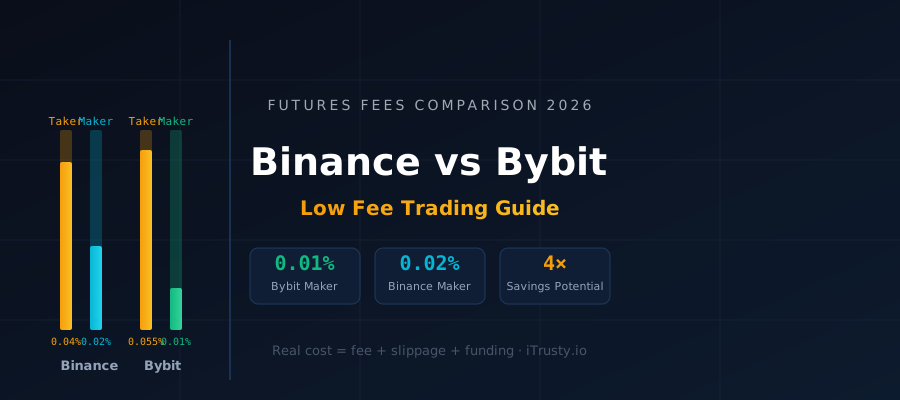
Bybit offers the lowest maker fee in the industry — 0.01% — along with deep derivatives liquidity, a robust liquidation engine, and professional risk management tools. Ideal for active futures traders using limit orders.
Open Account on Bybit →Binance — The Largest Futures Market
Binance holds ~36% of global derivatives market share with the deepest BTC and ETH order books. Optimal for large positions where liquidity and minimal slippage matter most.
Start on Binance →Institutional Conclusion
Crypto futures are not a shortcut to wealth. They are a tool for efficient capital management. Used correctly, they allow you to hedge risks, flexibly reallocate capital, and access greater market exposure. Used incorrectly, they become a deposit-draining accelerator — a financial vampire sucking money through commissions and funding, and an emotional roller coaster that breaks your psychology.
- The derivatives market is 76% of all crypto trading. You're operating in the price discovery epicenter.
- 97% of day traders lose money. Overconfidence is the greatest enemy.
- 2025 saw $1.5B liquidated in a single day. Cascades are real.
- 97% of volume trades on unregulated platforms. Choose your exchange consciously.
- Funding can cost 5–15% of exposure annually. Calculate before entry.
Professional futures trading is first and foremost about risk architecture, and only then about leverage size. Remember: the survivor is not the one who earns the most in a bull market, but the one who preserves capital in a bear market. Futures is a long game where the ultimate prize goes not to the most daring, but to the most resilient.
FAQ
What is liquidation in crypto futures?
Liquidation is the forced closing of your position by the exchange when your margin balance falls below the maintenance margin level. It happens automatically and instantly, without your consent. The exchange does this to protect itself and other traders from losses.
What leverage is optimal for a beginner?
No more than 2–3x for beginners. Even experienced professionals rarely use more than 5x on core capital. With 10x leverage, an 8% price drop leaves you with only 20% of your initial capital. With 20x — you're already liquidated.
How do I calculate the cost of holding a futures position?
Total cost = entry commission + exit commission + (funding per period × number of periods). For a $100,000 position at 0.02% funding per 8h over 10 days: ($100k × 0.05% × 2) + ($100k × 0.02% × 3 × 10) = $100 + $600 = $700. Your trade must generate at least 0.7% just to break even.
How do perpetual futures differ from regular futures?
Perpetuals have no expiration date and are kept pegged to spot through the funding mechanism. Regular (quarterly) futures expire on a set date, and their price converges to spot as expiry approaches. Perps account for ~68% of all BTC trading volume.
How do you protect against liquidation cascades?
Use moderate leverage (2–5x), set stop-losses in advance, keep 50%+ of capital as free margin, monitor liquidation heat maps (CoinGlass), and reduce positions before major macro events. The golden rule: if you cannot afford to lose the full position size — the position is too large.
Should you use DeFi platforms for futures?
DeFi derivatives (dYdX, GMX) offer advantages: transparency, no counterparty risk, anonymity. However, their liquidity is lower than CEX, and smart contract risks are real. For large positions (>$50,000), centralized exchanges remain the more reliable choice for now.