
What are futures on Bybit and why traders choose this exchange
If you've already tried spot trading and feel you want more opportunities, futures on Bybit — this is a logical next step. I've walked this path myself: from my first uncertain Bitcoin purchases on the spot market to systematic derivatives trading with clear risk management. And in this guide, I'll tell you everything you need to know to start trading futures on Bybit competently, consciously, and without typical beginner mistakes.
Bybit — this is the second-largest cryptocurrency exchange in the world by derivatives trading volume. The platform serves more than 77 million users from almost 200 countries, including Russia and CIS countries. The daily trading volume on Bybit's futures market exceeds $17 billion — this means deep liquidity, minimal slippage, and reliable order execution even during moments of high volatility.
A futures contract in cryptocurrency is, essentially, an agreement to buy or sell an asset at a pre-determined price. You don't need to own Bitcoin or Ethereum itself to earn on their movement. You simply enter into a contract, betting on the direction of the price — up (Long) or down (Short). This opens up a completely different level of trading opportunities compared to the spot market.
What advantages does trading futures on Bybit provide
Trading futures on Bybit gives three key advantages that are not available on the spot market.
First — the ability to earn on both market rises and falls. When Bitcoin falls, a spot trader simply watches his portfolio melt away. A futures trader opens a short position and makes a profit with each percentage of decline. In the context of a volatile crypto market, this is a critically important opportunity.
Second advantage — leverage. On Bybit, leverage up to 125x is available on major pairs like BTCUSDT and ETHUSDT, and up to 25–50x on altcoins. This means that with only $100, you can open a position for $10,000 at 100x leverage. Of course, leverage increases not only profits but also losses — we'll discuss this in detail below.
Third — hedging. If you have a portfolio of cryptocurrencies on the spot and fear a short-term market decline, opening a short position on futures allows you to insure your portfolio without needing to sell the assets themselves. This is a professional risk management tool used by institutional investors around the world.
What types of futures contracts are available on Bybit in 2026
Bybit offers three categories of futures contracts, each suited to different strategies and trader preferences. Let's break them down in detail so you immediately understand which type of contract to choose for your goals.
Perpetual contracts — the main tool for traders
Perpetual futures — this is the most popular type of contract on Bybit and the crypto market in general. Their main feature is that they have no expiration date. You can hold a position as long as you want — a day, a week, a month. The position closes only when you decide to do it yourself, or when liquidation occurs due to insufficient margin.
To prevent the price of a perpetual contract from diverging from the actual spot price of the asset, a Funding Rate mechanism is used — a periodic payment between traders that occurs every 8 hours. If most market participants are in a long position, longs pay shorts. If the market is skewed toward shorts — shorts pay longs.
Standard (dated) futures — for advanced strategies
Unlike perpetuals, standard futures on Bybit have a specific expiration date. Contracts are available for the current week, next week, third week, current month, next month, third month, current and next quarter. When the expiration date arrives, the contract closes automatically.
Standard futures are more often used for more complex strategies — for example, for arbitrage between spot and futures or for portfolio hedging. For beginners, I recommend starting with perpetual contracts — they are simpler to understand and manage.
Comparison table of contract types on Bybit
| Parameter | USDT Perpetual | USDC Perpetual | Inverse Perpetual |
|---|---|---|---|
| Settlement currency | USDT (Tether) | USDC (Circle) | Base asset (BTC, ETH) |
| Expiration | No (perpetual) | No (perpetual) | No (perpetual) |
| Max leverage | Up to 125x | Up to 125x | Up to 100x |
| Funding Rate | Every 8 hours | Every 8 hours | Every 8 hours |
| Suitable for | Profit locking in dollars | Working with USDC, portfolio margin | Accumulating crypto assets |
| Number of pairs | 800+ pairs | Main pairs | BTC, ETH and others |
What terms you need to know before your first trade
Before opening your first position, you need to understand the basic terminology of the futures market. I've seen people lose money simply because they didn't understand what "liquidation" meant or how "leverage" works. Here's a complete dictionary of key terms.
| Term | What it means in simple language |
|---|---|
| Margin | The collateral you put up to open a position. This is not the full value of the contract, only a portion of it. The higher the leverage, the less margin you need. |
| Leverage | A multiplier that increases the size of your position. 10x leverage turns your $100 margin into a $1,000 position. |
| Long | A buy position. You open it when you expect the price to rise. You make money when the price goes up. |
| Short | A sell position. You open it when you expect the price to fall. You make money when the price goes down. |
| Liquidation | Forced closing of a position by the exchange when losses reach a critical level and margin is no longer sufficient. |
| Funding Rate | A periodic fee (or payment) every 8 hours between longs and shorts to align the futures price with the spot price. |
| Mark Price | A fair calculated price that the exchange uses to determine liquidation. Protects against manipulation. |
| Stop Loss (SL) | An order that automatically closes a position with a fixed loss when a specified price is reached. |
| Take Profit (TP) | An order that automatically locks in profit when a target price is reached. |
| Unrealized PnL | Unrealized profit or loss on an open position. It becomes realized only after the trade is closed. |
| ADL (Auto-Deleveraging) | An automatic deleveraging mechanism in extreme market conditions. |
How to set up your account on Bybit for futures trading
Proper account setup — this is the foundation of safe trading. Let's go through each stage of preparation.
Step 1. Registration and security setup
Registration on Bybit takes just a couple of minutes. You go to the official website or download the mobile app, enter your email or phone number, create a password. But this is just the beginning — the most important things happen next.
Immediately after registration, set up all levels of security. Enable two-factor authentication via Google Authenticator — this is the mandatory minimum. Set up an anti-phishing code — a unique word that will appear in every email from Bybit. Use a unique password that is not used on any other website. If possible — link a hardware key (YubiKey). Account security — this is direct protection of your money.
Step 2. Completing verification (KYC)
Bybit requires identity verification for full access to platform features. Without KYC, withdrawal limits will be significantly restricted. The procedure is simple: you upload a photo of your passport or ID, take a selfie to confirm your identity. Usually verification takes a few minutes.
Step 3. Account funding and fund transfers
You can fund your Bybit account in several ways: transfer cryptocurrency (USDT, BTC, ETH, and others) from an external wallet, buy crypto for fiat through P2P trading, or through built-in purchasing services.
Important detail: Bybit uses a Unified Trading Account. Funds for futures trading should be on this account. If you topped up your balance and the funds ended up on your "Funding" wallet, you need to perform an internal transfer. No commission is charged for internal transfers.
Step 4. Activating a demo account for practice
Bybit provides a full-fledged demo account (Testnet) that allows you to trade futures with virtual money under conditions as close as possible to the real market. I strongly recommend starting with a demo account. Spend at least 2–4 weeks on it, practice opening and closing positions, learn to set stop losses and take profits.
Isolated or Cross margin on Bybit: which mode to choose
Choosing a margin mode — this is one of the first and most important decisions you make before opening a futures position on Bybit. It directly determines what portion of your deposit you risk losing in a single trade.
What is Isolated Margin
In Isolated Margin mode, you allocate a specific amount for each trade. This amount is your maximum loss on that particular position. If the price moves against you and liquidation occurs, you'll lose only the allocated margin — the rest of your balance on the account will remain untouched.
Example: you have 1,000 USDT on your account. You open a position with isolated margin of 300 USDT. Even if liquidation occurs, you lose a maximum of 300 USDT. The remaining 700 USDT are protected.
What is Cross Margin
In Cross Margin mode, your entire available balance on your trading account is used as collateral for the position. On one hand, this gives you more room before liquidation. On the other hand, one unsuccessful trade can wipe out your entire account in minutes with a strong market move.
Comparison of margin modes
| Criterion | Isolated Margin | Cross Margin |
|---|---|---|
| Risk of loss | Only allocated margin | Entire account balance |
| Distance to liquidation | Limited (depends on margin) | More (entire balance as buffer) |
| Risk control | Full — you know exactly the maximum loss | Weak — loss can be unpredictable |
| For whom | Beginners, systematic traders | Experienced traders, hedgers |
| Recommendation | Use in 99% of cases | Only if you understand all risks |
What leverage to choose on Bybit
Leverage — this is a tool that is simultaneously the main opportunity and the main threat of futures trading. Bybit offers leverage up to 125x on major crypto pairs. But the fact that the exchange allows you to use maximum leverage doesn't mean you should do it.
How leverage works: practical example
Suppose you have 100 USDT and want to open a long position on BTCUSDT:
| Leverage | Margin | Position size | Movement to liquidation | Profit at +5% |
|---|---|---|---|---|
| 2x | $100 | $200 | ≈50% | $10 (ROI 10%) |
| 5x | $100 | $500 | ≈20% | $25 (ROI 25%) |
| 10x | $100 | $1 000 | ≈10% | $50 (ROI 50%) |
| 25x | $100 | $2 500 | ≈4% | $125 (ROI 125%) |
| 50x | $100 | $5 000 | ≈2% | $250 (ROI 250%) |
| 100x | $100 | $10 000 | ≈1% | $500 (ROI 500%) |
Look at the table carefully. With 100x leverage, it takes just a 1% move against your position to lose your entire deposit. Bitcoin can easily move 1–2% in a few minutes — this is normal market volatility. With 2x leverage, you need an almost 50% move to lose your margin. This is a colossal difference in safety level.
What leverage to set as a beginner on Bybit
My rule, verified by personal experience: start with 2x–3x. Yes, profits will be more modest. But you'll be in the market, you'll be learning, and you'll preserve your capital. Increase leverage gradually only when you have stable positive statistics for 1–3 months. Leverage 5x–10x — this is the working range for experienced traders. Leverage above 20x — the realm of scalpers and algo traders.
What types of orders are available on Bybit Futures
Proper order usage — this is one of the key skills of a futures trader. Bybit has several types of orders available.
Market order
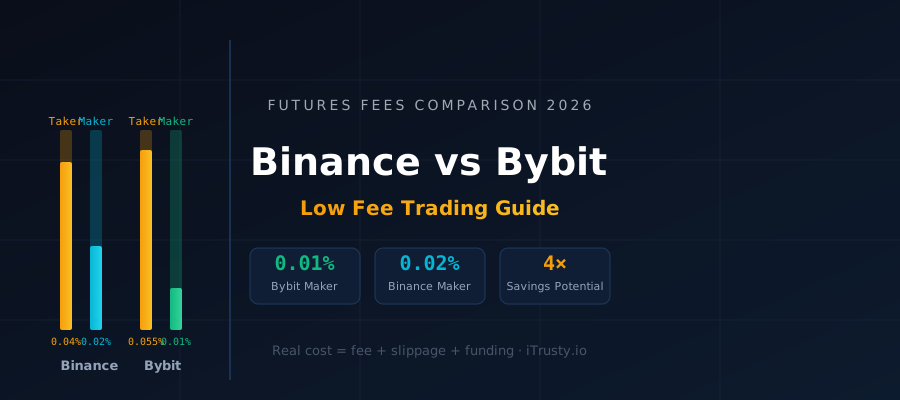
A market order executes instantly at the best available price in the order book. This is the fastest way to enter or exit a position. Disadvantage — possible slippage and higher taker fee (0.055%).
When to use: for urgent entry or exit when speed is more important than price.
Limit order
A limit order is placed in the order book at a price you specify and waits for the market to reach it. Advantage — full control of entry price and lower maker fee (0.02%). Disadvantage — no guarantee of execution.
When to use: for planned trade entry at a pre-determined price. This is the main order type for systematic traders.
Conditional order (stop order)
A conditional order triggers only when the price reaches a specific trigger. Bybit offers conditional market and conditional limit orders. This type is used for setting stop losses, take profits, and for entry when a level is broken.
Additional order settings
Bybit offers advanced parameters: GTC (Good-Till-Canceled) — the order remains active until execution or cancellation. IOC (Immediate-Or-Cancel) — executes immediately, remainder is canceled. FOK (Fill-Or-Kill) — executes fully or is canceled entirely. Post-Only — guarantees placement as a maker order. Reduce-Only — can only reduce position size.
Comparison of fees by order type
| Order type | Fee (regular) | Fee (VIP 1) | Fee (VIP Supreme) |
|---|---|---|---|
| Market (taker) | 0.055% | 0.040% | 0.030% |
| Limit (maker) | 0.020% | 0.018% | 0.000% |
| Conditional | Depends on execution type | As Market or Limit | As Market or Limit |
How to open your first futures trade on Bybit: step-by-step algorithm
Theory is behind us. Now let's go through the entire process of opening your first trade step by step.
Step 1. Determine your trading plan before entering a trade
Before opening a position, you must answer three questions: where is my entry? where is my stop loss? where is my profit target? If you can't clearly answer at least one of these questions — don't open the trade.
A trading plan is not "it seems to me Bitcoin will go up." It's specific levels on the chart, backed by technical analysis. For example: "Long entry on pullback to support level 94,500, stop loss at 93,800, target at 97,000. Risk/reward ratio 1:3.5."
Step 2. Calculate position size based on acceptable risk
This is the golden rule of risk management. Position size is determined not by "how much I want to earn," but by "how much I'm ready to lose."
Formula: $1,000 deposit, 1% risk = $10. Stop loss 2% below entry. That means position = $500 (500 × 2% = 10). At 5x leverage, margin = $100.
Bybit has a built-in futures calculator to calculate profit/loss, liquidation price, and position size. Use it before each trade.
Step 3. Choose a pair and set parameters
Go to "Trade" → "Futures" → select the contract you want (for starters — BTCUSDT perpetual). Set margin mode (Isolated), choose leverage (start with 2–3x).
Step 4. Set stop loss and take profit
On Bybit you can set TP and SL right when placing your entry order. Do this always, without exception. Stop loss protects you from catastrophic losses. Take profit locks in your profit.
Step 5. Open the position and monitor it
After setting all parameters, click "Open Long" (Buy/Long) or "Open Short" (Sell/Short). The position will appear in the "Positions" section at the bottom of the trading terminal with information about size, entry price, unrealized PnL, liquidation price, and ROI.
How Funding Rate works on Bybit futures
Funding Rate — this is one of the most underrated factors that can significantly affect the result of your trading. Especially if you hold a position for more than one day.
The mechanism is simple: every 8 hours (at 00:00, 08:00, and 16:00 UTC) there is an exchange of payments between traders in long positions and those in short positions. If Funding Rate is positive (which happens more often), traders in long positions pay those in short positions.
Example of Funding Rate impact on a position
Suppose Funding Rate is 0.01% per period, and you hold a long position of $10,000. Every 8 hours, $10,000 × 0.01% = $1 is deducted from you. Seems small? But that's $3 per day, $21 per week, about $90 per month. And if Funding Rate increases to 0.05% or 0.1% — the daily payment will be $15 or $30. It can completely eat away your profit.
How to use Funding Rate to your advantage
Before opening a position, always check the current Funding Rate. If it's high and working against you, this is another reason to wait or choose a different pair. Experienced traders use Funding Rate for arbitrage strategies: open a short on futures and a long on spot, earning Funding Rate as stable income.
Ready to Start Futures Trading?
Open an account on a trusted exchange and start trading futures with the risk management principles covered in this guide. Low fees, deep liquidity, advanced tools.
Affiliate links — we may earn a commission. Compare fees before choosing.
How to manage an open position: 7 practical techniques
Opening a trade — this is only half the battle. The true mastery of a trader shows in how he manages the position after entry.
1. Partial profit taking
When price reaches your first target, don't close the entire position. Lock in 30–50% of profit, and leave the remaining portion of the position running further, moving your stop loss to breakeven. This way you guarantee taking some profit and give the position potential for further gains.
2. Trailing Stop
Bybit supports Trailing Stop — a moving stop loss that automatically follows the price. This is the perfect tool for a trend: you protect accumulated profit without limiting the potential move.
3. Moving stop loss to breakeven
Once the position has moved into profit by 1.5–2 times your stop loss size, move the stop to your entry point (breakeven). Now in the worst case you'll exit at zero, not at a loss.
4. Don't average down a losing position without a system
One of the most common reasons for liquidation — this is "averaging down." The price moved against you, and you decide to add to the position to improve your average entry price. In practice, this usually increases a losing position and ends in liquidation. Averaging is acceptable only if it's planned in advance and is part of your trading system.
5. Daily loss limit
Set a rule for yourself: two-three losing trades in a row — trading for today is over. Close the terminal and do something else. The market will work tomorrow. But if you start trying to "make back" your losses in a tilted state, the result is almost always the same — account wipeout.
6. Keeping a trading journal
Record every trade: date, pair, direction, entry and exit price, position size, leverage, result, reason for entry and exit, and — most importantly — your emotional state. After a month or two you'll see patterns in your mistakes. A trading journal is your best teacher.
7. Monitoring through mobile app
Bybit's mobile app allows you to fully manage futures positions: change leverage and margin, place orders, receive push notifications. The interface supports Russian language, and TradingView charts are built right into the app.
Top 10 beginner mistakes on Bybit futures
I've spoken with hundreds of traders and seen the same mistakes over and over. Here's what guarantees account wipeout.
| № | Mistake | Why it's dangerous and what to do instead |
|---|---|---|
| 1 | Trading without a stop loss | Without SL, one strong move can destroy your entire deposit. Always set a stop before entering a position. |
| 2 | Leverage 50–100x "for speed" | At 100x, liquidation happens at a 1% move. Start with 2–3x and increase gradually. |
| 3 | Trading on emotion (FOMO, tilt) | Decisions made under fear or greed almost always lose money. Follow your trading plan. |
| 4 | Averaging down a losing position | Adding to a losing trade without a system increases losses and brings liquidation closer. |
| 5 | Ignoring Funding Rate | High Funding Rate can eat all profit from a long-term position. Check before entry. |
| 6 | Trading trash coins | Low-liquidity pairs have huge spreads and sharp moves. Start with BTC and ETH. |
| 7 | Risk more than 2% per trade | Even 5 losing trades in a row at 1% risk — that's minus 5%. At 10% risk — minus 50%. |
| 8 | No trading journal | Without records you don't see patterns in your mistakes and can't improve results. |
| 9 | Trying to "make back" losses after losses | Trading in tilt leads to increased leverage and position size — and more losses. |
| 10 | Trading everything at once | Focus on 2–3 pairs allows you to better understand their dynamics and make quality decisions. |
Strategies for trading futures on Bybit
I won't give you "signals" or a "guaranteed strategy." Such things don't exist. But I'll give you a framework — working approaches that you can adapt and test on a demo account.
Strategy 1: Trend trading
Essence: determine the direction of the main trend on a higher timeframe (4 hour or daily) and look for entry points in the trend direction on a lower timeframe (15 minutes — 1 hour). Entry on a pullback to a significant support level (for longs) or resistance (for shorts). Stop loss beyond the nearest local extreme. Minimum risk/reward ratio — 1:2, ideally 1:3 and higher.
Strategy 2: Trading from support and resistance levels
Essence: mark key horizontal levels where price repeatedly reversed. Wait for price to approach the level and for a confirming signal (candlestick pattern, false breakout, divergence). Don't enter just from the boundary — always need confirmation. Works well in ranging markets (consolidation).
Strategy 3: Breakout strategy
Essence: look for situations where price consolidates near an important level. On a breakout with increased volume, enter in the direction of the breakout. Stop loss at the opposite boundary of the range. It's important to distinguish true breakouts (volume increase, candle closes beyond level) from false ones (quickly returns back). False breakouts — great signals for entry in the opposite direction.
Strategy 4: Discipline — "don't trade"
This is not a joke. Sometimes the best trade is the one you didn't open. When the market is chaotic, just sit in stablecoins. Preserving capital during uncertainty — that's already a win. Professionals don't trade every day. They wait for their setups.
Risk management on Bybit futures: how to preserve and grow capital
Risk management — this is the only thing that separates consistently profitable traders from those who constantly top up their deposits.
Rule 1. Fixed percentage risk per trade
Risk no more than 1–2% of your deposit in a single trade. With a $1,000 deposit, this is $10–20. Even a series of 10 losing trades will take only 10–20% of your deposit, leaving you funds to continue trading.
Rule 2. Risk/Reward ratio minimum 1:2
If you risk $10, potential profit — minimum $20. At 1:2 ratio you only need to be right 40% of trades to stay in profit. At 1:3 — 30% is enough.
Rule 3. Maximum drawdown per day/week
Limits: daily drawdown — 3–5%, weekly — 10%. If the limit is reached, stop trading until the next period.
Rule 4. Diversification of positions
Don't put your entire deposit into one trade. Spread your risk. If you're trading BTCUSDT and ETHUSDT simultaneously, account for correlation: these pairs often move together, and two longs — this is effectively doubling your risk.
Tools and features of Bybit for futures trading
Built-in futures calculator
Calculate profit/loss, target price, liquidation price, and optimal position size before entering a trade.
TradingView charts
Bybit integrates with professional TradingView charts — both in the web version and mobile app. All popular indicators, drawing tools, and multiple timeframes are available.
Copy Trading on futures
If you're not yet confident in your skills, Bybit offers Copy Trading — copying trades of successful traders. You choose a trader by statistics (profitability, drawdown, followers) and automatically copy his futures trades.
Trading bots
Bybit offers built-in trading bots (Grid Bot, DCA bot) that automate strategies on the futures market as well.
Comparison of Bybit with other exchanges
| Parameter | Bybit | Binance | OKX |
|---|---|---|---|
| Number of futures pairs | 800+ | ~350 | ~450 |
| Max leverage (BTC) | 125x | 125x | 125x |
| Taker fee | 0.055% | 0.040% | 0.050% |
| Maker fee | 0.020% | 0.020% | 0.020% |
| Russian interface | Yes, fully | Yes | Partially |
| P2P (Russian cards) | Yes, unrestricted | With restrictions | Yes |
| Demo account | Yes | Yes | Yes |
| Copy Trading | Yes | Yes | Yes |
| Proof of Reserves | Yes, transparent | Yes | Yes |
Bybit stands out with the widest selection of futures pairs (over 800), full accessibility for users from Russia and CIS countries, a transparent Proof of Reserves system, and an intuitive interface. Bybit's VIP program allows you to reduce maker fees to 0%.
Checklist before every futures trade
Print this checklist or save it. Go through it before every trade — it takes 30 seconds but can save you hundreds and thousands of dollars.
| ✓ | Question before opening a position |
|---|---|
| □ | Do I have a clear trading plan (entry, stop, target)? |
| □ | Is the risk in this trade no more than 1–2% of my deposit? |
| □ | Is the Risk/Reward ratio at least 1:2? |
| □ | Have I chosen Isolated Margin mode? |
| □ | Does the leverage match my experience level (2–5x for beginners)? |
| □ | Have I checked the current Funding Rate? |
| □ | Will TP and SL be set at the same time as opening the position? |
| □ | Is this decision made without emotion, fear, or desire to break even? |
| □ | Have I not exceeded my daily loss limit? |
| □ | Am I ready to calmly accept the stop loss? |
Frequently asked questions about Bybit futures
Can you steadily earn money on Bybit futures?
Yes, but it requires discipline, a systematic approach, and time for learning. According to statistics, about 70–90% of beginner traders lose money in their first year. The reason — not in the tool, but in the lack of risk management and trading plan. Those who build a system and strictly follow the rules have real chances to reach stable profitability.
What's the minimum deposit needed?
Technically — a few dollars. However, I recommend starting with 100–300 USDT. This is enough to trade with 2–3x leverage while following risk management rules (1% risk per trade).
How do futures differ from spot trading?
Key differences: you don't own the asset, you trade a contract on its price. You can earn on both rises and falls. Leverage is available. There's Funding Rate. And most importantly — there's liquidation risk, which doesn't exist with spot purchases.
What to do if your position got liquidated?
Don't panic and don't try to "make back" the loss. Analyze the reasons: too much leverage? No stop loss? Record the takeaways in your trading journal. Go back to demo account if needed.
Is it safe to trade futures on Bybit?
Bybit — one of the world's largest cryptocurrency exchanges with transparent reserves (Proof of Reserves), two-factor authentication, an insurance fund, and a price manipulation prevention system (Mark Price). Platform security and trading safety — these are different things. Futures trading itself carries high risk.
How is futures profit taxed?
Tax regulation varies by country. It's recommended to consult with a tax specialist. Bybit provides trade history for tax reporting.
Conclusion: your action plan
Week 1–2: Register on Bybit, complete verification, set up security. Activate the demo account. Practice opening/closing positions, setting stop losses and take profits.
Week 3–4: Study the basics of technical analysis: support/resistance levels, trends, candlestick patterns. Choose one strategy and test it on a demo account. Start keeping a trading journal.
Month 2: Top up your real account (from 100–300 USDT). Trade with 2–3x leverage in Isolated Margin mode. Risk no more than 1% per trade. Trade only BTCUSDT, ETHUSDT. Continue keeping a journal.
Month 3 and beyond: Analyze your statistics. If positive — gradually increase position sizes and leverage (up to 5–10x). Add new pairs. Master Copy Trading, trading bots, portfolio margin.
Trading futures on Bybit — this is a powerful tool that can become a source of stable income with the right approach. The key to success — not in finding the "holy grail," but in discipline, risk management, and continuous learning. Be patient, be systematic, and results will come.