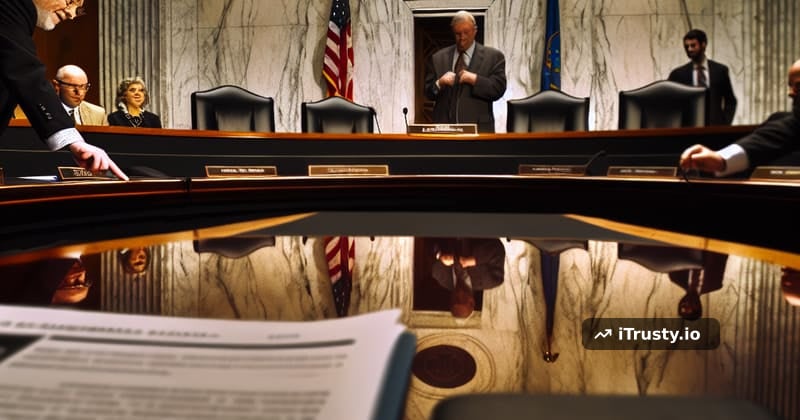
SEC Submits Crypto Securities Framework to White House Review

Yuki Nakashima
On-Chain Analyst
The SEC has delivered a landmark interpretive framework on crypto asset securities laws, now undergoing White House interagency review at the prerule stage.
The United States Securities and Exchange Commission has taken a decisive step toward establishing regulatory clarity in the digital asset space, formally submitting a commission-level interpretive framework to the White House that outlines how existing federal securities laws should apply to cryptocurrency assets. The document, currently navigating the prerule stage of interagency review, marks one of the most structured regulatory overtures the SEC has made toward the crypto industry in years — and signals that Washington is preparing to move from enforcement-first posturing toward something resembling a coherent, codified policy architecture for the sector.
The SEC's Long Road to Crypto Regulatory Clarity
For much of the past decade, the SEC's approach to cryptocurrency regulation has been characterized by enforcement actions, informal guidance, and a persistent reliance on the Howey Test — a legal framework dating back to 1946 — to determine whether a digital asset qualifies as a security. Critics from across the industry spectrum, including blockchain developers, institutional investors, and legal scholars, have long argued that this piecemeal, litigation-driven strategy creates an environment of legal uncertainty that stifles innovation and drives crypto businesses offshore. The submission of a formal interpretive framework represents a meaningful departure from that reactive posture. By elevating this guidance to commission level and routing it through White House interagency review, the SEC is signaling institutional seriousness — an acknowledgment that crypto assets require dedicated regulatory thought rather than retrofitted 20th-century doctrine. The prerule designation is significant: it means this is not yet binding law, but it carries substantial weight as a statement of regulatory intent and will shape how agencies, courts, and market participants interpret the legal landscape going forward.
What the Framework Could Mean for Crypto Regulation
While the full text of the interpretive guidance has not been made publicly available pending interagency review, the structural implications are already generating considerable discussion among regulatory attorneys and digital asset policy experts. Interpretive guidance at the commission level typically addresses how the SEC views specific categories of assets, transactions, or market participants under existing statutory authority. In the context of crypto, this could include formal articulations of which token characteristics trigger securities classification, how decentralization affects regulatory treatment, and what disclosure obligations apply to digital asset issuers. The interagency review process — which likely involves the Treasury Department, the Commodity Futures Trading Commission, and potentially the National Economic Council — adds another layer of complexity. Different agencies have long competed for jurisdictional authority over crypto markets, and a White House-level review suggests an effort to build cross-agency consensus before any formal rulemaking begins. This collaborative approach, if successful, could prevent the fragmented regulatory environment that has historically confused market participants trying to comply with overlapping federal mandates.
Market Implications for Crypto Investors and Businesses
For crypto markets, regulatory clarity has historically been a double-edged catalyst. On one hand, defined rules reduce legal risk for institutional players who have remained on the sidelines due to compliance uncertainty, potentially unlocking significant capital inflows into digital asset markets. On the other hand, a framework that broadly classifies crypto tokens as securities could impose registration, disclosure, and exchange-licensing requirements that many existing projects are structurally unprepared to meet. Bitcoin and Ethereum, both of which have received varying degrees of informal acknowledgment as non-securities, may be relatively insulated from the most disruptive classification decisions. However, the vast universe of altcoins, DeFi governance tokens, and yield-bearing digital assets could face substantial reclassification risk. Crypto exchanges operating in the United States would be particularly affected, as securities-classified tokens would require trading on SEC-registered platforms — a compliance bar that most current crypto exchanges do not yet meet. Investors should monitor how this framework evolves through the interagency review process and whether it ultimately leads to formal rulemaking or remains advisory guidance.
The Broader Policy Landscape and What Comes Next
The submission of this framework does not occur in a vacuum. It comes amid intensifying global regulatory activity, with the European Union's Markets in Crypto-Assets regulation now in force and jurisdictions from the United Kingdom to Singapore advancing their own digital asset rulebooks. American regulatory hesitation has already cost the country competitive ground, and policymakers across party lines have increasingly acknowledged that a functioning, innovation-friendly regulatory framework is a national economic priority. Congress has also been active, with multiple bipartisan crypto bills circulating in both chambers that seek to clarify the SEC-CFTC jurisdictional divide. The SEC's interpretive guidance, once finalized, could either complement or complicate these legislative efforts — providing regulatory grounding that lawmakers can build upon, or creating tensions if the agency's interpretation diverges from congressional intent. What is clear is that the era of regulatory ambiguity in American crypto policy is drawing to a close. The SEC's formal engagement with the White House on this matter suggests that the federal government is finally treating digital asset regulation as the systemic priority it has always been — and the industry, investors, and global markets will be watching every development closely as this framework moves through review.
Start Trading Crypto Today
Open an account on a trusted exchange and trade 600+ cryptocurrencies with low fees.
Yuki Nakashima
On-Chain Analyst
Reads blockchain data fluently. Covers large wallet flows, exchange reserve shifts, whale accumulation patterns, and network health metrics across major chains.
View author profile