
Choosing a crypto exchange is not a matter of religion or habit. It's a question of structural compatibility with your trading style. In a world where every spread and every tenth of a percent in fees compounds into thousands of dollars of lost opportunity over time, you can't rely on "everyone does it this way".
In this guide we conduct a maximally honest and impartial deconstruction of two industry titans — Binance and Bybit. We won't hand out "winner" or "loser" labels. Instead, we'll break down the architecture of their liquidity, the cost math for different trader types, and try to look 10 years ahead to understand whose business model will better survive the test of time.
1. Architectural Snapshot: Two Philosophies of One Industry
Before comparing fees under a microscope, let's look at these platforms as living organisms. Each has its own DNA, muscles and skeleton.
| Metric | Binance | Bybit |
|---|---|---|
| Core identity | Hyperscalable crypto-ecosystem | Specialized trading platform focused on derivatives |
| Spot liquidity depth | Top-tier globally. Deepest order book. | High on majors (BTC, ETH), moderate on second-tier altcoins |
| Futures liquidity | High, distributed | Extremely high on perpetual contracts |
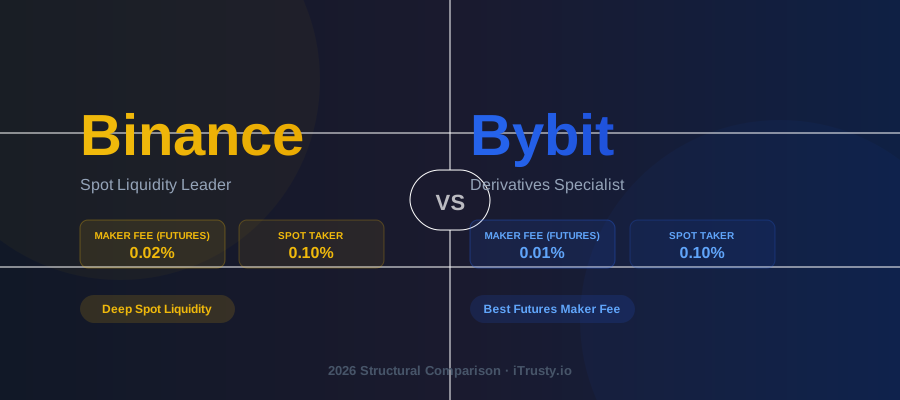
| Maker fee (Futures, base) | 0.02% | 0.01% |
| Taker fee (Futures, base) | 0.05% | 0.06% |
| Base spot fee | 0.10% | 0.10% |
| Ecosystem products | Massive: Earn, Launchpad, Web3 wallet, NFT, P2P | Focused: Trading, copy trading, Launchpad 2.0 |
| Best use case | Traders and investors with diversified portfolios | Active derivatives traders, scalpers, market makers |
Binance builds a city. Bybit builds a skyscraper for trading. The choice depends on whether you need the whole city with its parks and shops, or you just came to work in a specific office.
2. Spot Trading: Where Liquidity Beats Math
Many think spot trading is simply "buy low, sell high." But it's actually a battle against an invisible enemy — slippage. Here Binance has a structural advantage that's difficult to overcome.
Scenario A: Large spot position $20,000 (market execution)
Both exchanges have identical taker fees of 0.10%. The key variable is order book depth.
| Parameter | Binance (Deep liquidity) | Bybit (Moderate on altcoins) |
|---|---|---|
| Trading commission (round-trip) | $40 | $40 |
| Estimated slippage | $8–$12 | $12–$20 |
| Effective full round-trip cost | $48–$52 | $52–$60 |
| Annual cost (300 trades) | $14,400–$15,600 | $15,600–$18,000 |
Trade on Binance — World's Deepest Spot Liquidity
Access the world's largest spot order book. Lowest slippage on major and mid-cap altcoins. Up to 20% fee discount for new users.
Open Binance Account →3. Futures: Maker's Paradise and Taker's Hell
The futures market is Bybit's territory. They've sharpened their platform to razor precision. The difference in maker fees (for those placing limit orders) becomes not just a number, but the foundation of a strategy.
Scenario B: Large futures trader with maker strategy
Conditions: Notional position $500,000, 400 trades per year. Trader uses limit orders, adding liquidity.
| Parameter | Binance | Bybit |
|---|---|---|
| Maker fee | 0.02% | 0.01% |
| Round-trip cost (entry+exit) | $200 | $100 |
| Annual trading cost | $80,000 | $40,000 |
| Funding (neutral market, 0.01%) | ~$18,000 | ~$18,000 |
| Total estimated annual cost | ~$98,000 | ~$58,000 |
Trade Futures on Bybit — Best Maker Fees in 2026
0.01% maker fee on perpetual contracts. Industry-leading fee structure for active traders. Copy trading and advanced order types included.
Open Bybit Account →4. Funding Rate: The Great Equalizer
Funding is dictated by the market — the ratio of long and short positions — not the exchange's will. Here both players face the same forces.
Swing position held 7 days, $200,000 exposure
| Funding Rate | Binance Cost | Bybit Cost |
|---|---|---|
| 0.01% per 8h (normal) | $420 | $420 |
| 0.02% per 8h (elevated) | $840 | $840 |
| 0.03% per 8h (impulse spike) | $1,260 | $1,260 |
Bybit, as a more derivatives-oriented exchange, can sometimes experience stronger funding spikes on altcoins due to a smaller base of hedgers. For swing traders holding positions for weeks, funding often outweighs the difference in trading commissions.
5. Liquidity in Section: From Bitcoin to the Altcoin Zoo
| Asset Type | Binance | Bybit |
|---|---|---|
| BTC/USDT | Extremely deep | Very deep |
| ETH/USDT | Extremely deep | Very deep |
| Top-20 altcoins | Deep | Moderate to high |
| Mid-cap altcoins | Deep | Moderate |
| Long-tail tokens (low-cap) | Wide coverage | Limited presence |
6. Risk Infrastructure: How Exchanges Protect Your Positions
| Component | Binance | Bybit |
|---|---|---|
| Insurance fund | Large, diversified | Significant, focused on derivatives |
| Auto-deleveraging (ADL) | Yes | Yes |
| Cross-margin | Yes | Yes |
| Portfolio margin | Available | Available |
| Liquidation transparency | Moderate | Often rated clearer in interface |
7. Capital Efficiency: Spot vs Futures
| Strategy Parameter | Spot (1x) | Futures (10x leverage) |
|---|---|---|
| Required capital | $100,000 | $10,000 |
| Exposure | $100,000 | $100,000 |
| Fee impact on capital | Low (relatively) | High (relatively) |
| Funding rate | None | Every 8 hours |
| Liquidation risk | None | Yes |
8. 10-Year Structural Forecast (2026–2036)
| Structural Factor | Binance Forecast | Bybit Forecast |
|---|---|---|
| Regulatory integration | Continues adapting through regional licenses, becoming a "crypto multinational corporation" | Will optimize jurisdictions, possibly exiting some markets for efficiency |
| Fee compression | Gradual reduction for all, but premium retention through ecosystem | Aggressive maker incentives, fees may approach zero for top clients |
| Institutional adoption | Strong integration through custodial solutions and partnerships | Strong niche in derivatives for hedge funds and prop trading |
| Web3 integration | High potential — Binance may bridge CeFi and DeFi for millions | Moderate, focused on trading DeFi solutions |
| Liquidity consolidation | Win through ecosystem scale effect | Consolidation around derivatives clusters |
9. Final Matrix: Who Are You as a Trader?
| Your Profile | Structurally Better Choice |
|---|---|
| Large spot allocator (altcoin investor) | Binance — deeper order book across broader asset spectrum |
| High-frequency futures trader (scalper, maker) | Bybit — half the maker fee |
| Swing futures trader (holds positions days/weeks) | Depends on funding environment — choose exchange with less L/S imbalance on your coin |
| Multi-asset investor (Hold+Trade) | Binance — manage everything in one window |
| Pure derivatives specialist | Bybit — ergonomics and speed |
| Diversified risk manager | Both — holding capital on two platforms is the best insurance |
10. iTrusty's Position: In the Silence of the Lab
We at iTrusty don't take sides in brand battles. We look at charts and numbers.
- Binance dominates in ecosystem coverage and scale of spot liquidity. This is the choice for those who value versatility and readiness for any scenario.
- Bybit maintains a strong competitive advantage in derivatives trading efficiency, especially for maker strategies where every hundredth of a percent matters.
There is no universal winner here. There is a question of fit.
11. Mathematical Simulation: 5 Years of Difference
Starting capital: $100,000. Gross annual strategy return (before fees): 18%. Annual reinvestment. No additional deposits.
| Year | Optimized 15% net | Moderate 13% net | High Cost 10% net |
|---|---|---|---|
| 1 | $115,000 | $113,000 | $110,000 |
| 2 | $132,250 | $127,690 | $121,000 |
| 3 | $152,087 | $144,289 | $133,100 |
| 4 | $174,900 | $163,046 | $146,410 |
| 5 | $201,135 | $184,242 | $161,051 |
Optimized (3% costs, maker on Bybit) vs High Cost (8% costs, taker fees + funding) = $40,084 difference over 5 years on a $100,000 portfolio.
12. Extended Simulation: High-Frequency Futures Trader
Starting capital: $50,000. Average leverage: 8x. Gross return on exposure (before fees): 12%.
- Scenario A (Efficient environment, maker on Bybit): 4% structural costs → 8% net return on exposure → 64% return on capital
- Scenario B (Higher cost, taker orders): 7% structural costs → 5% net return on exposure → 40% return on capital
A 3% difference in exposure costs translates into a colossal difference in capital returns. Leverage amplifies not only profit, but also the cost of mistakes — including commission errors.
13. Final Assessment
Binance and Bybit represent two structurally different, but equally globally competitive models.
- Binance — scale, breadth, depth. The choice for strategic investors who want access to the entire market from one window.
- Bybit — specialization in derivatives, maker competitiveness, and design built for the trader. The choice for those who live in the futures order book.