
Most traders believe their accounts drain due to bad market entries. They blame intuition, poor signals, or market manipulation. But the reality is often more prosaic and ruthless: people lose money because they never truly understood the full cost of a trade. Trading fees on crypto exchanges are not a boring line in a fee schedule — they are a fundamental structural component of your trading performance.
At iTrusty we analyzed thousands of retail trader patterns on spot and derivatives markets. And we saw a consistent pattern: traders catastrophically underestimate the full cost of executing an order. They look at the chart but don't see the hidden saw that's grinding down their profits.
Why Fees Matter More Than Strategy Refinement
Consider two traders working the same market. Trader A has an impressive 55% win rate. Trader B is slightly less accurate at 53%. On paper, Trader A looks like the favorite. But Trader B is disciplined about cost management — he reduces total execution cost per round-trip by 0.3% compared to his colleague.
Assume each makes 300 trades per year with an average position size of $20,000:
Trader B's savings per trade: $20,000 × 0.3% = $60
Annual savings: $60 × 300 = $18,000
Anatomy of Fees: Makers and Takers
99% of centralized exchanges use the Maker / Taker model:
- Maker (Market Creator): You place a limit order — posting a bid/ask that others can fill. You add liquidity to the order book. Exchanges reward you with lower fees.
- Taker (Market Consumer): You place a market order — filling existing orders immediately. You remove liquidity. The exchange charges you the full taker fee.
Average Global Exchange Rates in 2026
| Market | Role | Fee Range |
|---|---|---|
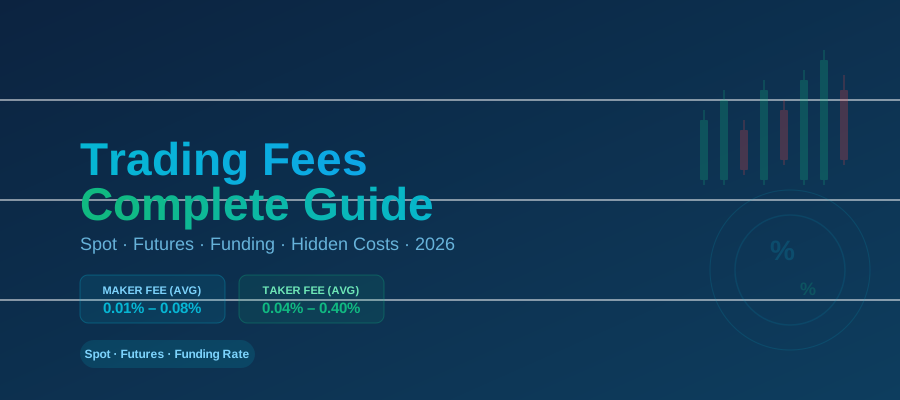
| Spot | Maker | 0.08% – 0.10% |
| Spot | Taker | 0.10% – 0.40% |
| Futures (Perpetuals) | Maker | 0.01% – 0.02% |
| Futures (Perpetuals) | Taker | 0.04% – 0.06% |
Rates shown are for standard (non-VIP) accounts. Native token discounts (BNB, OKB) can reduce costs by 10–25%.
Real Example: Spot Trader with $10,000 Capital
- Average position size: $10,000
- Taker fee: 0.1% (most common mistake — always using market orders)
- Frequency: 40 trades per month × 12 = 480 trades/year
Cost per round-trip (entry + exit): $10,000 × 0.1% × 2 = $20
Annual fees: $20 × 480 = $9,600
But this is just the beginning. There's also slippage.
Spread and Slippage: The Invisible Hand of the Market
When you enter with a market order, you don't execute at one ideal price — you fill across a chain of orders in the book. If liquidity is thin, each successive order executes at a slightly worse price. The difference between expected price and average execution price is slippage.
Assuming modest slippage of 0.04% per side:
| Cost Type | Per Round-Trip | Annual (480 trades) |
|---|---|---|
| Exchange fees (0.1%) | $20 | $9,600 |
| Slippage (0.04%) | $8 | $3,840 |
| Total structural cost | $28 | $13,440 |
Futures Math: Leverage Multiplies Everything, Including Fees
Futures fees are calculated on the full notional position size, even though you only post a fraction as margin.
- Full position size (notional): $50,000
- Your margin (at 10x leverage): $5,000
- Taker fee: 0.05% · Trades per year: 200
Round-trip cost: $50,000 × 0.05% × 2 = $50
Annual fees: $50 × 200 = $10,000
As % of margin: $10,000 / $5,000 = 200% of your margin annually in fees alone
To break even on fees at this leverage and frequency, you need to earn 200% annually — before we even count funding.
Funding Rate: The Silent Position Killer
Funding is a unique mechanism of perpetual futures that anchors their price to spot. If futures price is above spot (bull market), long positions pay short positions. Many beginners open a position and forget it. Meanwhile, funding drips every 8 hours.
| Funding Rate | Position Size | Daily Cost | 10-Day Cost |
|---|---|---|---|
| 0.01% per 8h (normal) | $50,000 | $15 | $150 |
| 0.03% per 8h (elevated) | $50,000 | $45 | $450 |
| 0.05% per 8h (bull run) | $50,000 | $75 | $750 |
In trending markets, funding costs can easily exceed trading commissions. Always check funding rate history before holding perpetual positions.
Liquidity: The Real Secret to Low Fees
Here's a paradox that 90% of traders miss. You want to buy Bitcoin for $100,000:
| Exchange | Fee | Slippage | Real Total Cost |
|---|---|---|---|
| Exchange A (thin order book) | 0.08% | 0.15% | 0.23% |
| Exchange B (deep order book) | 0.10% | 0.03% | 0.13% |
By paying the exchange slightly more, you saved twice as much on market impact. Liquidity is queen. Market depth matters more than the headline fee.
Hidden Fees: Where the Money Really Goes
- Conversion fees: "Instant Convert" and "Buy with card" buttons often embed hidden markup of 0.3%–1%+. Always use spot pairs with limit orders.
- Withdrawal fees: Network choice matters enormously. Ethereum (ERC-20) can cost several dollars; TRC-20 (Tron) or BSC is pennies. Always check before withdrawing.
- Margin interest: Variable interest accrues on borrowed funds. Long-held leveraged positions incur substantial charges.
- Liquidation fee: If forced liquidation occurs, the exchange adds a penalty fee on top of your loss.
Structural Choice: Spot or Futures?
| Factor | Spot Trading | Futures Trading |
|---|---|---|
| Funding rate | None | Every 8 hours |
| Liquidation risk | None | High with leverage |
| Asset ownership | Full | Synthetic only |
| Base commission | Higher (0.10%) | Lower (0.02–0.05%) |
| Capital efficiency | 1x | Up to 100x |
| Best for | Investors, swing traders, beginners | Experienced traders, scalpers, hedgers |
Professional Approach to Cost Optimization
- Compare Taker/Maker rates, not just headline numbers — look at the fee table for your volume tier
- Study VIP programs — even moderate volume often qualifies for discounts; holding exchange tokens (BNB, OKB, MX) reduces fees further
- Analyze order book depth — see how your typical trade size affects execution price before entering
- Monitor funding rates — include them in profit calculations; avoid holding long-term positions in overheated markets
- Use limit orders — try to be a Maker; if execution isn't urgent, set a limit and wait (saves fees + improves discipline)
- Split large orders — instead of one $100,000 market order, place several limit orders at different price levels to reduce slippage
Compound Effect of Saving on Fees
Starting capital: $100,000. Gross annual return: 18%. Annual reinvestment.
| Year | Scenario A — 13% net (5% costs) | Scenario B — 16% net (2% costs) |
|---|---|---|
| 1 | $113,000 | $116,000 |
| 2 | $127,690 | $134,560 |
| 3 | $144,289 | $156,090 |
| 5 | $184,244 | $210,034 |
| 7 | ~$235,000 | ~$283,000 |
Same trading skill, same market — but ~$48,000 difference after 7 years from fee optimization alone (2% cost difference compounded annually).
How to Choose an Exchange in 2026
- Compare total cost (not just fee): Taker fee + expected spread + average deposit/withdrawal cost
- Evaluate liquidity specifically for your coins — Bitcoin is liquid everywhere, altcoins vary dramatically
- Check the legal status of derivatives in your country — not all exchanges offer futures to all regions
- Analyze funding rate stability — on some exchanges funding is more volatile
- Research withdrawal speed and cost before depositing
Compare Top Exchange Fees Side by Side
Ready to choose the right exchange? See our full comparison of Binance, Bybit, OKX, Kraken and Coinbase — fees, KYC, futures, and country restrictions.
View Full Exchange Comparison →Crypto markets are volatile. Prices jump, sentiment shifts, news shocks. But there is one constant — transaction cost. Fees are predictable. Most traders spend 99% of their time trying to predict the unpredictable. And only 1% of their time minimizing the friction they can control. But as we've established, it is friction that ultimately determines market survival. Execution cost management is not a detail. It is the foundation of your trading infrastructure.