
Choosing an exchange in 2026 is not just about "where is it cheaper". For traders, the critical factors are the combination: liquidity → fees → execution → country/regulatory availability → KYC → instruments (spot/futures). Below is an overview of the key centralized exchanges, a fee comparison, and practical recommendations on which exchange is better for spot trading, which for futures, and where country and verification restrictions most commonly arise.
Exchanges We're Comparing and Why
This article covers five exchanges most commonly evaluated by both beginners and experienced traders:
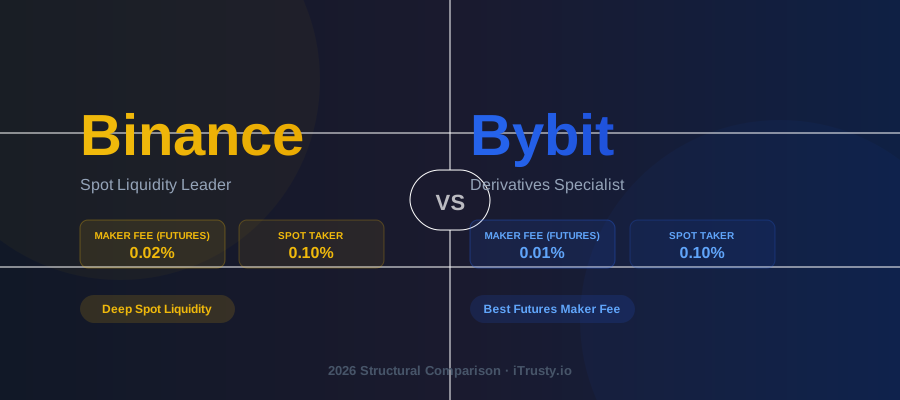
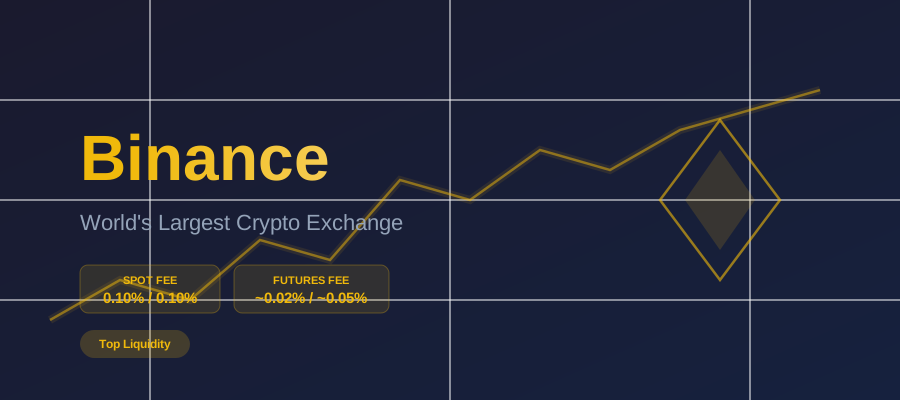
- Binance — the largest ecosystem with high spot liquidity, extensive infrastructure, and a wide product range. Base spot fee for regular users: 0.10% / 0.10% (maker/taker), with BNB payment discounts and VIP tiers available.
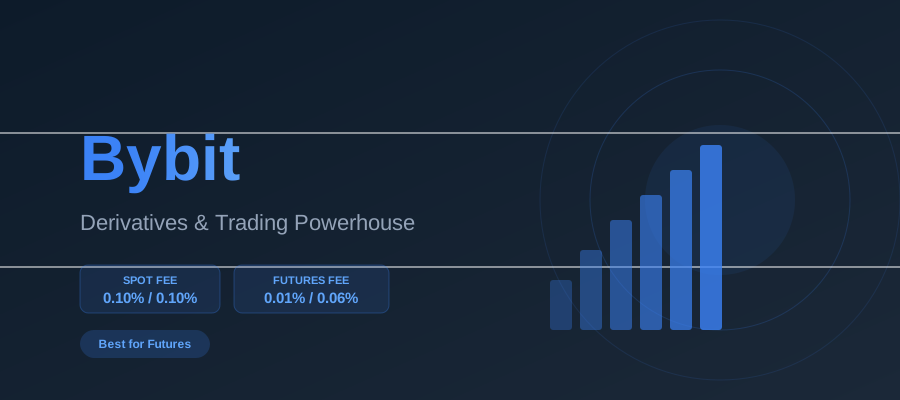
- Bybit — core strength in derivatives, an active trading community, and intuitive trading modes. Official Bybit documentation states base Non-VIP rates for both spot and derivatives, plus separate VIP fee structures.
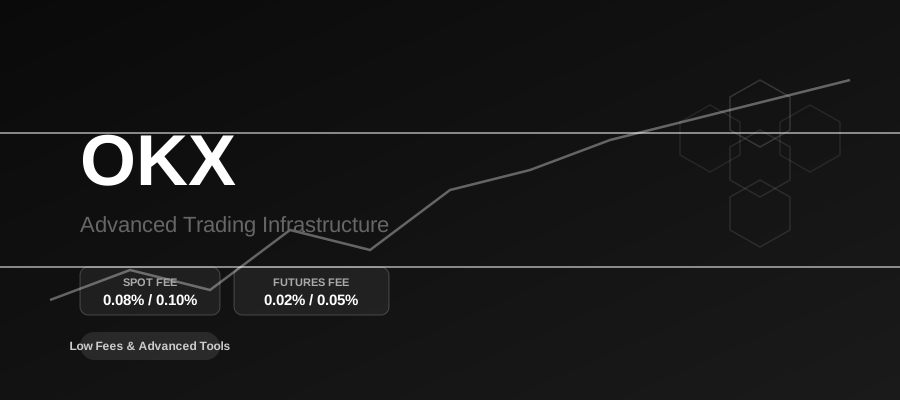
- OKX — advanced trading tools with comparatively low spot fees (regular users typically cited at 0.08% maker / 0.10% taker), plus well-developed derivatives.
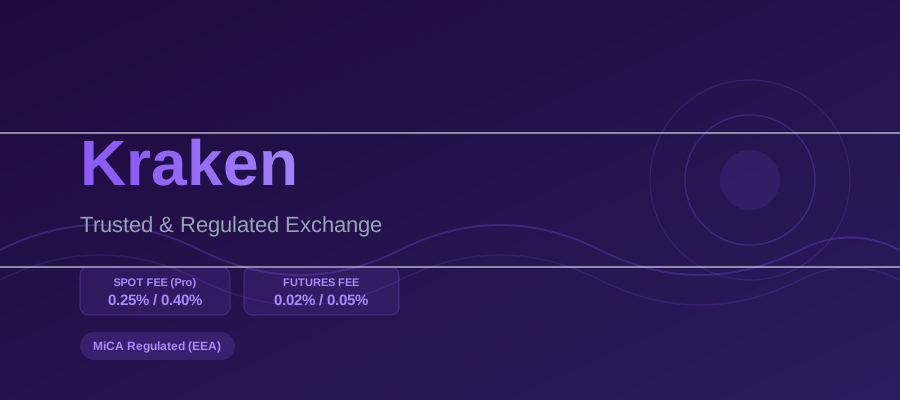
- Kraken — strong on compliance, fiat gateways, and reputation for US/EEA users; spot fees are higher than "Asian" exchanges, but legal transparency is a key advantage. Their fee schedule explicitly lists rates by volume tier.
- Coinbase — important for the US and parts of Europe; high "regulatory accessibility," though Advanced Trade fees are often noticeably higher than global exchanges. Their help center confirms the maker/taker structure and upper rate bounds.
How to Compare Fees Correctly (and Why "0.1%" Isn't Everything)
A brokerage fee is only part of the total trading cost. The real "price" of a trade consists of:
- Maker/Taker fee — order execution commission
- Spread and slippage — especially on low-liquidity altcoins
- Funding rate — for perpetual futures
- Deposit/withdrawal fees — including network fees
- Hidden restrictions — KYC tiers, withdrawal limits, product restrictions in your country
The tables below show base fees for ordinary/low-volume users. We then explain where spot trading wins and where futures trading wins.
Spot Fees: Base Tier Comparison
The figures below are reference points for a beginner or "average" trader. Every exchange has a VIP schedule that reduces rates with higher turnover or balance.
| Exchange | Base Spot Fee (maker / taker) | Notes |
|---|---|---|
| Binance | 0.10% / 0.10% | Binance fee table shows 0.100%/0.100% for Regular User; BNB discount and VIP tiers available |
| Bybit | 0.10% / 0.10% | Non-VIP rates from Bybit's "Fees You Need to Know" page; regional/product-specific pages may differ |
| OKX | 0.08% / 0.10% | OKX spot fee materials show "from 0.08% maker / 0.10% taker" for regular users |
| Kraken Pro | 0.25% / 0.40% | Kraken Pro fee schedule: 0.25% maker / 0.40% taker at $0 trailing 30-day volume, decreases with volume |
| Coinbase Advanced | ≤0.40% / ≤0.60% | Coinbase notes that maker/taker rates depend on trailing volume; upper bounds around 0.40%/0.60% |
Note: On specific markets/pairs and when using internal tokens or liquidity programs, fees may differ from the base rates shown.
Futures & Derivatives Fees: Base Tier Comparison
With derivatives, it's not just the commission that matters. Also consider:
- Order book depth on your instruments
- Engine stability during volatile markets
- Margin rules, auto-deleveraging, insurance fund
- Jurisdictional restrictions (some countries ban derivatives even when spot is available)
| Exchange | Base Derivatives Fee (maker / taker) | Notes |
|---|---|---|
| Bybit | 0.01% / 0.06% | Bybit Non-VIP perpetual & futures rates from "Fees You Need to Know" |
| OKX | 0.02% / 0.05% | OKX contract fee example: maker 0.02%, taker 0.05% for a standard level |
| Kraken Futures | 0.0200% / 0.0500% | Kraken Futures fee schedule: 0.0200% maker / 0.0500% taker at $0 volume |
| Binance | ~0.02% / ~0.05% | Reference rates for U-margined contracts; official promotional materials cite "as low as 0.02%" maker; actual rates may vary by promo |
Always verify the current fee schedule on the exchange's official fee page before trading.
Best Exchange for Spot Trading
Maximum market exposure
Binance is most often chosen for its deep liquidity on major and many alt pairs, convenient ecosystem (earn, conversions, P2P in select regions), and a clear base fee of 0.10%/0.10% with discounts and VIP tiers.
OKX often beats Binance on "pure math" for spot (base rate 0.08% maker / 0.10% taker) while also offering extensive advanced tools.
If fiat access and compliance matter (bank transfers, regulatory maturity), then Kraken/Coinbase may be simpler for onboarding — but review the commissions carefully.
| Your priority | Recommended |
|---|---|
| Fees + liquidity + pair selection | Binance / OKX |
| Simple fiat on/off-ramp in a regulated environment | Kraken / Coinbase |
Best Exchange for Futures Trading
Active derivatives focus
If your focus is perpetual futures, leverage, and intraday trading, the top choices are typically:
- Bybit: competitive base rates, strong derivatives UX (Non-VIP: maker 0.01%, taker 0.06% per official docs)
- OKX: strong derivatives stack; documentation shows maker ~0.02% / taker ~0.05% for standard tiers
- Binance: massive liquidity, but check derivatives availability in your country first
| Your priority | Recommended |
|---|---|
| Best derivatives UX + fees | Bybit / OKX |
| Liquidity and ecosystem | Binance (if derivatives available in your jurisdiction) |
KYC: Verification Levels and Why They Matter
In 2026, virtually all major exchanges follow this logic:
- No KYC — reduced limits, sometimes no fiat operations, some products and promotions unavailable
- Standard/Basic — unlocks main features
- Advanced/Pro — higher withdrawal limits and access to certain features/products
Bybit describes Standard / Advanced / Pro individual verification levels, noting that benefits and withdrawal limits depend on level. For some regions (e.g., Bybit EU), KYC may be mandatory at Standard level minimum.
Kraken directly publishes deposit/withdrawal limits by verification status (e.g., Standard and Higher limits tiers).
OKX documents its KYC levels (Basic/Advanced/…) with higher levels unlocking higher limits and access.
Binance documentation explains that verification level affects account limits and available features.
Country Restrictions and Product Availability
This is critical: restrictions come in two types:
- The exchange is entirely unavailable in a country/region
- Spot is accessible, but derivatives, fiat operations, or cards/earn are restricted
Bybit publishes a list of "Excluded Jurisdictions" including the US, mainland China, Hong Kong, Singapore, Canada, and several sanctioned/conflict regions.
Binance publishes a list of countries/regions where the app is supported. Binance Futures may additionally be unavailable in certain countries due to regulatory changes (the list may update).
Kraken states it welcomes clients globally "with a few exceptions" based on regulation; functionality may depend on confirmed residency and verification level. Kraken also announced servicing all EEA countries under a MiCA-regulated structure — important for European users.
Coinbase has historically focused on strictly-regulated markets; availability of individual products (including derivatives) depends on jurisdiction.
Overall Comparison: Which Exchange Suits Whom
| Profile | Best exchange | Key reason |
|---|---|---|
| Beginner — one exchange for everything | Binance / OKX | Universal spot + ecosystem, competitive fees |
| Active futures trader | Bybit / OKX | Best derivative UX and rates; Binance for liquidity |
| US user / strictly regulated environment | Kraken / Coinbase | Compliance, bank options, predictable terms |
| Diversified trader | Binance + Bybit | Spot on one, futures on the other |
Checklist Before Registering
- Check exchange and product availability in your country (especially derivatives)
- Review maker/taker fees at base level and what discounts are available
- Understand KYC requirements: what level is needed for deposits/withdrawals/fiat
- Assess liquidity on your instruments (pairs, perps, volumes)
- Check withdrawal fees on your networks (ERC-20/TRC-20/Arbitrum etc.)
- For futures: factor in funding rates and risk parameters (margin/liquidation)
Summary and Risk Warning
When choosing a crypto exchange, fees alone don't tell the full story. Liquidity, country availability, KYC requirements, trading engine stability, and derivatives access all play important roles.
Summing up the Binance, Bybit, OKX, Kraken, and Coinbase comparison:
- Best for spot trading (liquidity + fees + selection): Binance and OKX
- Best for futures and derivatives (trading focus): Bybit and OKX; Binance if derivatives are available in your jurisdiction
- Best for regulated fiat access (US/EEA, compliance): Kraken / Coinbase (usually higher fees)
Many experienced traders split capital across multiple exchanges to reduce operational risk, compare fees, and use the best conditions for different trade types.